Showing posts with label 52 in 52. Show all posts

Sunday, December 30, 2012

2012 Complete Reading List with Links


What a fun year!

What a fun year! 

ABBREVIATIONS KEY:
ITC - Invitation to the Classics List
GB - 100 Great Books List
SBC - Suburban Book Club
BB or BD - Book Babes or Dames
ER - Early Reviewer

JANUARY
1. Animal Farm (BD/GB - 9.5)
2. Hanna's Daughters (BB - 8)
3. The Broke Diaries (BB - 7)
4. Their Eyes Were Watching God (BD/GB - 9.5)
5. The Shape of the Eye (BB - 8)
FEBRUARY (lots of reading on vacation!)
6. Tom Sawyer (GB - 9.5)
7. Othello (GB)
8. Julius Caesar (GB)
9. The Awakening (GB)
10. King Lear (GB)
11. Romeo and Juliet (GB)
13. Billy Budd (GB)
15. Daisy Miller (GB)
16. Ethan Frome (GB)
17. David Copperfield (GB)
18. Brave New World (GB)
19. The Tempest (GB)
20. Macbeth (GB)
MARCH (Spring break reading!)
25. The Crucible (GB)
28. Lord Jim (GB)
29. Song of Years (BB 6 - 3 months to read!)
30. Lord of the Flies (GB)
31. Candide (GB)
37. The Pearl (GB)
APRIL
41. Steppenwolf (GB)
42. The Bluest Eye (GB)
46. Missions and Money (KC)
SEPTEMBER
79. The Joy Luck Club (GB)
82. Sons and Lovers (BD/GB)
83. Faust: Part 2 (GB/ITC)
84. A Separate Peace (GB)
86. Peace (ITC)
87. The Frogs (ITC)
OCTOBER
89. All the King's Men (GB)
90. The Plague (GB)
91. A Farewell to Arms (GB)
92. Catch-22 (GB)
93. House Made of Dawn (GB)
94. Twelfth Night (GB)
96. Dubliners (ITC)
97. Nichomachean Ethics (ITC)
98. Prayer Walk (ER)

Wednesday, December 26, 2012

52 in 52 Week 52: Handel's Messiah: Comfort for God's People

Handel's Messiah: Comfort for God's People Unabridged Audiobook on CDWhen I first started trying to listen to this in 2010, I thought: BORING! The narrator sounded very stuffy, and it went on about Italian Oratorio and all that, but I gave it a second try Christmas season 2011. I sat down and really listened to it. It is a WEALTH of insight and information about this masterpiece! I loved it. If you are a Messiah Geek like me, it will benefit you greatly to understand the ins and outs of this gift from Handel!

If you are not a Messiah geek, it may be a bit too academic, but I listened to it again this Christmas, and I found myself wanting to write down quotes.  I listen to a little of the book and then the part of the music he has just described. I love that I go to bed and wake up with these Scripture songs in my head during the Christmas season because CHRIST is what the season is all about!  

It will be my annual tradition!

Update: I read the print in 2013, and I like that much better!


Sunday, December 23, 2012

2012 Reading Wrap Up


1) How many books did you read this year?  123 

2) Did you meet or beat your own personal goal? Beat goal of 52


3) Favorite book of 2012? (You can list more than one or break it down by genre)

Fiction: Middlemarch and Their Eyes Were Watching God

Non-Fiction: The Diary of Anne Frank

4) Least favorite book of 2012 and why?  


Steppenwolf - It is just a yucky book. Strange. I don't care if it is a classic. 

The Bluest Eyes is a close second.

5) One book you thought you'd never read and was pleasantly surprised you like it?


The Hunger Games trilogy - I had friends bug me to read them for a long time, and I was pleasantly surprised. It totally fit in with my Dystopian novel phase. Most of my Jesus Community and my kids read them and liked them. (I would love to discuss because most people who put them down don't get the author's point.)


6) One book you thought you'd love but didn't?


Song of Years by Bess Streeter Aldrich


She is so beloved by so many in the Book Babes Book Club. I REALLY wanted to like it, but it was chore to get through, and that is unusual for me. The story just didn't grab me. Too many sweeping years and not enough deeper character development. I had liked her other books, but I didn't like this one. I loved The Rim of the Prairie, but I think this was because it was a tighter time frame, less characters, and a much tighter plot line. Read her, and don't let my evaluation of this one book scare you away. She is a great writer. 

7) One book that touched you - made you laugh, cry, sing or dance.  


Little Women (reread) - it has all those elements.


8) Any new to you authors discovered and you can't wait to read more of their stories? 

Zora Neale Hurston - Their Eyes Were Watching God


What a beautiful writer! I listened to the Ruby Dee narration. PERFECT! 

9) Name the longest book you read? 


Middlemarch.  

Shortest? 

The Greatest Thing in the World 

10) Name the most unputdownable book you read? 


The Hunger Games Trilogy - gobbled them up!

11) Book that had the greatest impact on you this year?  


All Quiet on the Western Front - What is war for?

12) What book would you recommend everybody read? 


All Quiet on the Western Front 

13) Share your most favorite cover(s). I had two: 


Click image to view full cover 


14) Do you have a character you fell in love with? 


David Copperfield (what's not to like?) followed by Dorothea in Middlemarch.

15) What was your most favorite part of the challenge? Did you do any of the mini challenges? 


It encouraged me to finish my 100 Great Books List. I liked writing reviews. It helped me think through the books more deeply. I think I did the Dickens mini-challenge. I cannot remember. 

What are your goals for the new year? 


1.  Finish remaining 14 books on the  Invitation to the Classics List (Full list linked above):

Ancients - finished 12/12

Medieval - 11/13

  1. 1400's The Second Shepherd’s Play (tried to read over Christmas but unsuccessful)
  2. 1536 Institutes of the Christian Religion – Calvin
Early Modern 15/21
  1. 1633 The Temple – Herbert
  2. 1670 Pensees – Pascal
  3. 1746 A Treatise Concerning Religious Affections – Edwards
  4. 1759 Essays and Rasselas – Johnson
  5. 1791 The Life of Samuel Johnson, LL.D. – Boswell
  6. 1787 The Federalist – Hamilton, Madison, Jay (1/4 of the way through but will make it my 4th of July patriotic reading)
Modern 24/30 
  1. 1864 Apologia pro vita sua – John Henry Newman
  2. 1843 Fear and Trembling – Kierkegaard
  3. 1888 Twilight of the Idols – Nietzsche
  4. 1935 Four Quartets – T.S. Eliot
  5. 1942 Go Down, Moses – Faulkner
  6. 1950 Waiting for God – Weil 
2. Read Catcher in the Rye for the Book Dames (Classics) Book Club

3. Read Dandelion Wine and A Year of Biblical Womenhood: How a Liberated Woman Found Herself Sitting on Her Roof, Covering Her Head, and Calling Her Husband "Master" for the Suburban Readers Group.

What book are you most looking forward to reading in 2013?  

Pensees by Blaise Pascal because it is so often quoted in other books.  I have started, and it is a bit difficult for me to get through.

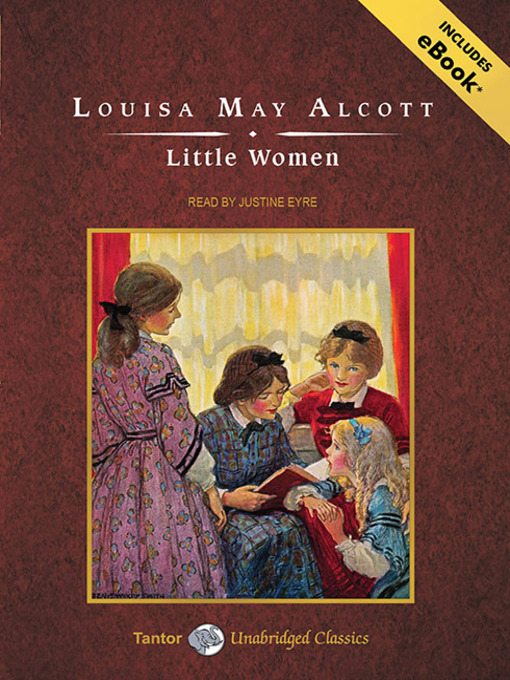
52 in 52 Week 52: Little Women by Louisa May Alcott


Cover image for Little WomenAfter reading contemporary Christmas stories that lacked brilliance, it was so nice to come home to a bright and shining classic of American literature! It was a great way to end the year of reading. 

While this story doesn't qualify as a "Christmas book," the story starts out with the four March girls lamenting the fact that they were too poor to truly enjoy Christmas. Many of the major movements in the book do happen around this holiday. Since I make up the rules on the "December of Christmas reads," this officially qualifies now.

If you have never read this book, you need to. If you read it a long time ago, you will read it again with more relish. Even though this was my third time through, it had been a while, and it still delighted me! I fell in love all over again with the impetuous and feisty Jo, prim and proper Meg, sweet and selfless Beth, and the striving and artistic Amy. Throw in the wisdom of Marmy and the stability of father, and you have quite a story!

This is my first time listening to an audio version, and I am sure people saw me and wondered why this tall girl was walking in the rain SMILING! 

Justine Eyre's narration is a bit nasal but not too distracting. She grew on me, and she did a nice imitation of male characters and people with accents. 

I love this book!

52 in 52 Week 52: The Greatest Thing in the World


Love has got everything to do with it. Love this analysis of 1 Corinthians 13 by the Scottish evangelist, Henry Drummond. I listened to the LearnOutLoud.com audiobook by Seth Anderson.

I agree with this review on LibraryThing.com by sacredstacks:

The Greatest Thing in the World is taken from an address Henry Drummond, a Scottish evangelist, delivered to a gathering of friends in England in 1884. It is based on the 13th chapter of First Corinthians (the Love chapter).  
The Greatest Thing in the World
I couldn't find a better picture!

The inspiration behind this work includes the fact that the author was a geologist/explorer by profession. “As a Christian, he combined his knowledge of science with his understanding of the Creator and His many diverse creations.” In Chapter 3, Love Analyzed, he draws from his professional background to make a remarkable analysis. Using the way a prism breaks down light into many components of color, he demonstrates the way Paul breaks the spectrum of love down into the elements of patience, kindness, generosity, etc. The author goes on to write a section about each of these attributes. They all speak to our “horizontal” relationship with man as opposed to our “vertical” relationship with God. The prism illustration is a very compelling one; and I consider it to be the highlight of this book. The author begins Chapter 4, Love Defended, with Paul’s reason for singling out love as the supreme possession. Despite the many things man may focus on, love lasts. It never fails. 

The biblical truths examined in this book will give you a fresh perspective on life and love. Totally convinced of love’s power in everyday life, Drummond challenges believers to read the actual text of 1st Corinthians 13 once a week for the next three months. This compact book could easily function in today’s market as a commentary, which I’ve learned to refrain from using. The author’s treatment of 1st Corinthians 13, however, is a rare exception. I recommend it wholeheartedly. 

Saturday, December 22, 2012

52 in 52 Week 51: God is in the Manger by Dietrich Bonhoeffer

I am not done with this because the devotional goes through January 6, but it is FREE now. See the link below.

I don't know if it will free when I finish it on January 6. So, I am posting it today!

This contains delightful excerpts from many of his letters and writings. It is a daily devotional reading that averages about 3 minutes a day and goes from the first Sunday in advent to Epiphany on January 6th. I don't want anyone to miss it. You can always listen to it next year if you don't want to be "behind" for this year. :)


http://christianaudio.com/god-is-in-the-manger-dietrich-bonhoeffer

NOTE: I finished it December 27th. I couldn't wait until January 6th! So good. Very rich.

Tuesday, December 18, 2012

52 in 52 Week 51: The Christmas Sweater by Glenn Beck

Continuing on my quest to get through Christmas books given to me over the years, I give you The Christmas Sweater. It was OK. There are a few twists and turns, and it is semi-autobiographical. It could have used some editing in some places and some expansion in others. There was so much time setting up the story prior to the climax that the ending seemed really rushed. Then, there wasn't enough development of some of the characters. I am not sure I liked it. It was just OK. I know it was just OK because I read two Lucy Maud Montgomery Christmas short stories immediately following, and I was delighted. It isn't a bad book though. Just not up there with books of really, really good authors.  Sandwiched between Dickens and Montgomery, Beck did not have a prayer. 

Sunday, December 16, 2012

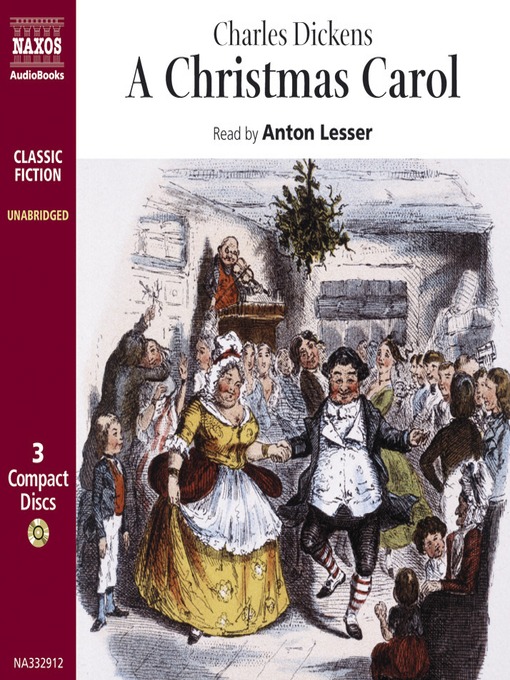
52 in 52 Week 51: A Christmas Carol

I could have sworn I already wrote a review of this, but I cannot find it in my list of posts. 

Remember last week when I talked about the tradition of telling "ghost" stories on Christmas Eve during the Victorian Era? This is the quintessential ghost story, and I had to redeem my respect for Dickens after reading his short stories that I reviewed last week. 

This book does not disappoint. I read it once for my book club and once to my children as a read aloud, but that was probably more than ten years ago. I had never listened to it, and this NAXOS audio version has the best narrator AND classical music in the transitions. It is a TREAT! I checked it out on my Library2Go.com account. THE BEST!

My respect (and love) for Dickens has been restored. 

52 in 52 Week 51: On Prayer and the Contemplative Life by Aquinas


BY THE

VERY REV. HUGH POPE, O.P., S.T.M.

AUTHOR OF "THE CATHOLIC STUDENT'S 'AIDS' TO THE BIBLE," ETC.

WITH A PREFACE BY

VERY REV. VINCENT McNABB, O.P., S.T.L.

R. & T. WASHBOURNE, LTD.
PATERNOSTER ROW, LONDON
AND AT MANCHESTER, BIRMINGHAM, AND GLASGOW
1914 All rights reserved

This is taken from the second part of the second part of the Summa Theologica (II-II). It takes out the structure of the Summa (theological question or statement, objections to the question or the statement, a quotation of an opinion or a statement that contradicts the objections, the answer to the question, and the refutation of the objections). I like that, but some people don't. 
I wanted a closer read of the part of the Summa that is more practical. I would have been a great nun. :) I love to pray. 
I have already explained about the larger work of the Summa in the previous post. 
You can get this book free on the Kindle at Amazon.com or you can get it in many different forms from Project Gutenberg HERE.

Some of the stuff on praying to saints was not part of my theological beliefs, but I loved this quote from the contemplative life section:

S. Thomas: We do not enjoy all the things that we have; and this is either because they do not afford us delight, or because they are not the ultimate goal of our desires, and so are incapable of satisfying our yearnings or affording us repose. But these three things the Blessed have in God: for they see Him, and seeing Him they hold Him ever present to them, for they have it in their power always to see Him; and holding Him, they[Pg 182] enjoy Him, satisfying their yearnings with That Which is The Ultimate End (Summa Theologica, I., xii. 7, ad 3m).

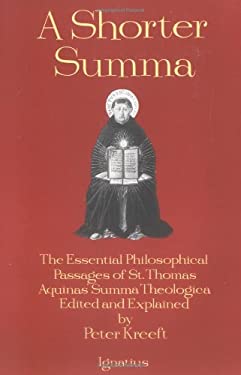
52 in 52 Week 51: A Shorter Summa (Theologica) by St. Thomas Aquinas


The entire Summa is about 3,000 pages long, and most of it is Scripture so I would rather just read the Bible to get my theology, but Aquinas' work is so influential in Western thought that I needed to at least read a book like Kreeft's that is an anthology of the Summa using Aquinas' actual words. Kreeft also has a Summa of the Summa that is 500 pages, but I opted for this even more concise version that is under 200 pages. It is not "about" the Summa but gives the most important parts in a concise readable form. I figured this was enough to "count" for my Invitation to the Classics List!

So, what is the Summa? I didn't know until I saw it on my list. I will let Wikipedia explain it to you: 


The Summa Theologiæ (written 1265–1274 and also known as the Summa Theologica or simply the Summa) is the best-known work of Thomas Aquinas (c.1225–1274). Although unfinished the Summa is "one of the classics of the history of philosophy and one of the most influential works of Western literature."[1] It is intended as a manual for beginners in theology and a compendium of all of the main theological teachings of the Catholic Church. It presents the reasoning for almost all points of Christian theology in the West. The Summa's topics follow a cycle: the existence of God; Creation, Man; Man's purpose; Christ; the Sacraments; and back to God. 
Among non-scholars the Summa is perhaps most famous for its five arguments for the existence of God known as the "five ways" (Latin:quinque viae). The five ways occupy one and one half pages of the Summa's approximately three thousand five hundred pages.
Throughout the Summa Aquinas cites Christian, Muslim, Hebrew, and Pagan sources including but not limited to:Christian Sacred Scripture,Aristotle, Augustine of Hippo, Avicenna, Averroes, Al-Ghazali, Boethius, John of Damascus, Paul the Apostle, Dionysius the Areopagite,Maimonides, Anselm, Plato, Cicero, and Eriugena. 
(From: http://en.wikipedia.org/wiki/Summa_Theologica) 
It is interesting to note that "At the Council of Trent (1545-63), which formulated basic Catholic teaching for succeeding centuries, his Summa was placed on the altar alongside the Scriptures" (Invitation to the Classics, p. 93). Aquinas also wrote a summary of theology for missionaries to the Muslims called the Summa contra Gentiles.
Where the Summa Theologiæ was written to explain the Christian faith to theology students, the Summa contra Gentiles is more apologetic in tone, as it was written to explain and defend the Christian truth in hostile situations against unbelievers, with arguments adapted to fit the intended circumstances of its use, each article refuting a certain heretical belief or proposition. Instead of a mere elucidation of the length and breadth of Christian truth, Aquinas explains specific core articles of Christian belief.[1]
(From: http://en.wikipedia.org/wiki/Summa_contra_Gentiles) 
The Summa Theologica contains 604 main questions with many sub questions that total over three thousand! After the question, there are objections followed by his position and concluded by the answers to the objections. Apparently, this reflected the debates that were going on at the universities at the time. 
A rational nature seeks to "make sense," to be coherent and comprehensive, to understand how a thing fits together with others in order to find its place in the larger scheme of things. Theology is an attempt to make sense" out of faith--to see how what is revealed in Scripture relates to what we know through our experience, both in everyday life and in science. (Invitation to the Classics, p. 94)
I am not big on theology. As I told my friends who were gathered around a picnic table hotly debating theology one summer afternoon in 2001, "I just don't 'think' about God." This was followed by uproarious laughter because they all knew I had been studying and leading Bible studies  for over 30 years (www.3yearbiblebookclub.blogspot.com). I don't think about God just as I don't "think" about my husband, I LOVE him. I ADORE him. I want to KNOW him. I don't want to THINK ABOUT him!  So that is where I get hung up on theology.

BUT I believe this is how some people's brains work. So, I have slowly and painfully tried to read theology in order to become "all things to all men." I like Piper and Tozer, but they make it so practical. I still struggle with Dallas Willard's The Divine Conspiracy because it is too philosophical and just not practical. But others gobble it up. Therefore, I muddled my way through it, twice (Part of my reason for not thinking that book is too earth-shattering is that I say, "Duh, isn't this how all believers should live? Isn't it obvious? Don't people already know this stuff about the Kingdom of God?" But apparently not for those raised in a traditional church culture. I was nurtured in the Navigators which was radically different and more like what Willard describes. The Navigators were more practical than Willard though. I do like Willard's Spiritu of the Disciplines though. But I digress. . .) 

Summa means "summary," but it isn't a "summary" when it is twice as long as the source of the summary, the Bible!  That is why Paul Kreeft's Shorter Summa was PERFECT! In addition, I will read On Prayer and the Contemplative Life which takes from the much more concrete Second Part of the Second Part (II-II) of the Summa Theologica. In this part . . . 
Aquinas argues for the superiority of the contemplative life in our return to God--a life absorbed in thought about God, living in his presence--over a life dedicated to activity, wholesome and necessary though that might be. Aquinas's own life was a mixture of the contemplatives and active lives, with the aim of presenting to others the fruits of contemplation.
The is more my cuppa' tea!

LATE BREAKING BULLETIN ..............................................................

I wrote all the above introduction before I read the "Endnotes" of The Shorter Summa (What nerd reads the Endnotes? Answer: ME!), and even St. Thomas sort of came to the same conclusion: 


Here is how St. Thomas described his Summa explaining why he could not finish it, after he had had a "mystical experience" (the correct description is "infused contemplation"): "I can write no more; compared with what I have seen, all I have written seems to me as straw" (Endnote #2, Kindle Edition, Location 1564-67)
I REST MY CASE!!!!! It isn't about "thinking" about God, it is about a relationship with Him! 

Even Invitation to the Classics encourages the reader to "thumb through the Summa, exploring the questions of most personal interest to gain a sense of the whole. (p. 96 - I just read that so I am not "cheating" by reading The Shorter Summa!) Even The Shorter Summa was difficult for me to get through, but I did enjoy the whole section on "happiness" (means "complete well-being" and not what we normall attach to this word in modern day) because it lined up directly with what I read in Aristotle's Ethics.  But I could have told you what His conclusion would be: complete well-being can only come from God.

Here are the "Issues to Explore" from p. 96:

(1) How is philosophic reason related to faith?

It approached faith from a different angle and has its place in the world. Many people think that way. So, I succumb to the way God made them. I don't know if answers to objections really convinces people to follow Christ though. It is a supernatural encounter with a relational God.

(2) How does Aquinas understand embodiment as essential to humanness? How does this relate to the resurrection?

I am too dumb to answer this question. HELP!

(3) How are general human virtues related to the theological virtues? 

All men are created in the image of God. So, there are glimmers of God in everyone. The full manifestation of God cannot be realized until we are reconciled to Him through Jesus though. Our happiness can only be derived from Him.  It helps to have read Nicomachean Ethics by Aristotle and his writings on moral human virtues. 

Sunday, December 09, 2012

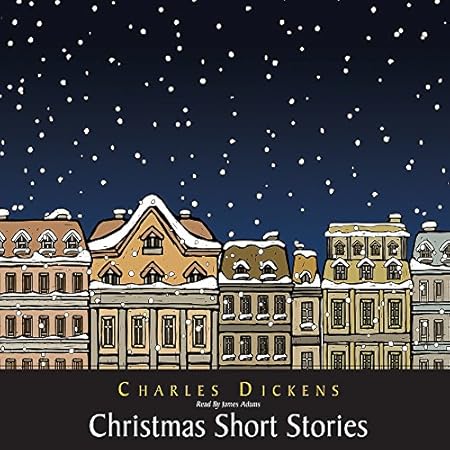
52 in 52 Week 50: Christmas Short Stories by Charles Dickens

 Macabre! My husband asked me how I was enjoying the book while we were lifting weights today, and I said, "It is so weird. The story I am listening to now is about dead people!" 

This led my youngest son to comment that the Andy William's song, "It's the Most Wonderful Time of the Year" does have that weird line about "telling scary ghost stories."  This led me to this REALLY interesting article:

"Telling Ghost Stories is a Lost Tradition on Christmas Eve"

Apparently, ghost stories were really common during the Victorian Era, and the quintessential ghost story is Dickens' A Christmas Carol! So, it would follow that his short stories would also have that flavor. 
“Whenever five or six English-speaking people meet round a fire on Christmas Eve, they start telling each other ghost stories,” wrote British humorist Jerome K. Jerome as part of his introduction to an anthology of Christmas ghost stories titled “Told After Supper“ in 1891. “Nothing satisfies us on Christmas Eve but to hear each other tell authentic anecdotes about specters.”
 Fascinating! This was not my favorite read especially compared to the Favorite Stories of Christmas Past I just read. I realized that that audiobook was by all but one American author. I don't know if the "ghost stories" of England were as popular here! 

It was good to get a dose of Dickens Shorts though. Here is a list of the stories:


"A Christmas Tree" - This is the macabre one that analyzes the Christmas tree, and then it just gets rambling and weird about death and ghosts. I did not really care for it, but here is a review of it:


"What Christmas is as We Grow Older" - Not bad, but not anything earth-shattering

"The Poor Relation's Story" - This one is more likeable. I liked this one.

"The Child's Story" - I liked this second best, but what strange stories to tell for Christmas!

"The Schoolboy's Story" - This one was the most interesting


"Nobody's Story" - Is this where we get our term "bigwig"?

52 in 52 Week 50: Favorite Stories of Christmas Past by Various Authors

 This is a precious audiobook of many classic stories. I got it for free from Tantor Audio last year but didn't have time to read it once it until this Christmas season.  

It only $6.00 on Tantor Audio this year, and it is well worth the cost. It comes with an eBook too. I went back and forth between listening and reading. because, as much as I wanted to like her, the female narrator was SO ANNOYING. I know she is an award-winning narrator, and she does accents and men well; but she puts on a syrupy sweet narrator voice that sounds like she is reading to two year olds. It really distracted from the beautiful stories.  


The male narrator is really good though. So, you only have to endure the female narrator for half the time.   I will briefly comment on each, and I have linked many of the actual stories since they are all public domain:


"Twas the Night Before Christmas" by Clement C. Moore - This is the classic story read masterfully by Alan Sklar.

"The Story of Christmas" by Nora A. Smith - This was the first narration by Renée Raudman, and it was appropriate to have that voice. I thought she was reading like this because it is a story for children. I was so wrong.

"A Country Christmas" by Louisa May Alcott - The narrator really ruined this story. I need to go back and read it in the eBook to really appreciate it (couldn't find it on my computer at that point). The women are so syrupy. I am sure it is a good story, but I liked it least of all because of the narration.

"An Empty Purse" by Sarah Orne Jewett - I had adjusted to the female narrator enough to LOVE this story. It is all about giving at Christmas. GREAT MORAL to the story! I think I liked it best of all, and it is a short 17 minutes of listening. After repeated emails back and forth with the professor in charge of her stories, I could only access this link through the "cache" version when you get the broken link message.  It worked for him on Firefox, but it did not work for me in Chrome or my husband's with IE. Who knows why!

"The Bachelor's Christmas" by Robert Grant (the link is to an 1895 Google Books version complete with illustrations)  - This was read by the man, and it was such a precious story. I felt like sending it to my single friends.

"The Fir Tree" by Hans Christian Andersen - Excellent! It is a story about contentment.

"The Birds' Christmas Carol" by Kate Douglas Wiggin - Bring tissue. This is a totally precious story. I love that the main character is named Carol because that is my name! I love my name, given to by God through my dad who thought, the minute I popped out, that there was no way I was a Karen ("Pure One"), and I must be called Carol ("Song of Joy"). He overruled my mother's wishes in naming me Carol, and that was a God thing. He did not know that I would grow up to be a singer, that my full name, Carol Ann, is an inverse of Anna Carolina, my grandmother's Swedish name, and finally that Carol is the feminine version of his name, Charles. I was my dad's daughter. But I digress. This is a BEAUTIFUL story, and I am delighted to see that Project Gutenberg has it in all forms with the original illustrations!  Read it today!

"Yes Virginia, There Is a Santa Claus" by Francis Church - Classic! The link is to pictures of the actual paper in which the editorial appeared. It is at the Newseum in Washington, D.C. Too bad we missed it on our trip there in July.

"The Festival of St. Nicholas" by Mary Mapes Dodge - I just happened to listen to this ON St. Nicholas Day. Imagine that! This is from Chapter IX of Hans Brinker and the Silver Skates. I have a copy that is inscribed, "Charles, March 1924." Given to my father (who was not a reader) by my grandmother (who desperately wanted him to be).

"The Gift of the Magi" by O. Henry - The story that was later made into several movies.


Loved this!

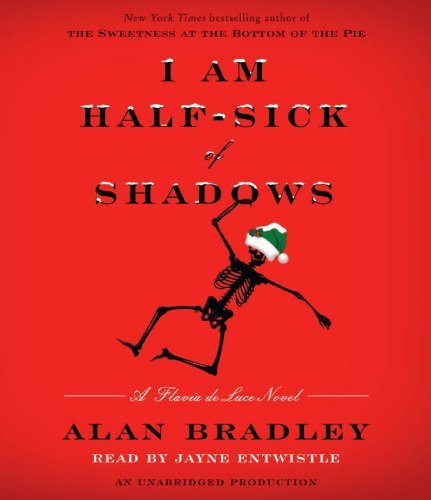
52 in 52 Week 50: I am Half Sick of Shadows by Alan Bradley

What better Christmas surprise for detective-in-training Flavia de Luce than a dreadful murder under Buckshaw's roof - and a snowbound house full of suspects!
It's Christmas time, and our beloved Flavia is tucked away in her laboratory whipping up a sticky concoction to trap that infamous sneak, Saint Nick, and thereby prove once and for all - despite the claims of her evil sisters - that he does exist. But she is soon distracted from her task: Colonel de Luce, in desperate need of funds, has rented the family's crumbling manor house to a film company for the holidays. When its crew arrives from London to shoot a movie starring the reclusive and renowned actress, Phyllis Wyvern, there's no end to the disruptions - and dramas - demanding Flavia's attention. (From:http://www.randomhouse.ca/books/196414/i-am-half-sick-of-shadows-by-alan-bradley)


I don't know if I ever would have picked up this book if it hadn't been that my new book club was reading it. I am reading Christmas books in December (have a stack given to me from Christmas past that I have never read!). So, I thought this counted, but it really isn't a "Christmas Book" other than the time setting, but it is delightful. It isn't anything deep or meaningful, but the writing is brilliant and beautiful, and the precocious main character, Flavia, is a kick. I found myself chuckling through many parts as I listened to the flawless narration by Jane Entwistle (who narrates the other three novels as well). I have listened to many audiobooks over the years, and I think that Jane ranks as one of the best narrators.

This is the fourth installment of the Buckshaw Chronicles. I love novels set in the English manor houses. The sister reading Bleak House cracked me up. I could totally see this being a BBC mini-series and delighting the whole family (even though it is a murder mystery series). 

The only thing that was unusual is that the murder occurred so late in the book! I had to go back and check whether it was really a murder mystery, but, no matter, it was still delightful!

By the way, The title of this book comes from the famous "Lady of Shalott" poem by Alfred Lord Tennyson (Remember Anne Shirley in a sinking boat?):

PART II

  There she weaves by night and day
  A magic web with colours gay.
  She has heard a whisper say,
  A curse is on her if she stay [5]
  To look down to Camelot.
  She knows not what the 'curse' may be,
  And so [6] she weaveth steadily,
  And little other care hath she,
  The Lady of Shalott.

  And moving thro' a mirror clear
  That hangs before her all the year,
  Shadows of the world appear.
  There she sees the highway near
  Winding down to Camelot:
  There the river eddy whirls,
  And there the surly village-churls, [7]
  And the red cloaks of market girls,
  Pass onward from Shalott.

  Sometimes a troop of damsels glad,
  An abbot on an ambling pad,
  Sometimes a curly shepherd-lad,
  Or long-hair'd page in crimson clad,
  Goes by to tower'd Camelot;

  And sometimes thro' the mirror blue
  The knights come riding two and two:
  She hath no loyal knight and true,
  The Lady of Shalott.

  But in her web she still delights
  To weave the mirror's magic sights,
  For often thro' the silent nights
  A funeral, with plumes and lights,
  And music, went to Camelot: [8]
  Or when the moon was overhead,
  Came two young lovers lately wed;
  "I am half-sick of shadows," said
  The Lady of Shalott. [9]

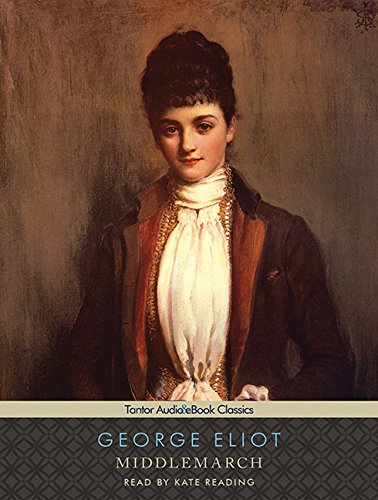
52 in 52 Week 50: Middlemarch by George Eliot

I LOVE George Eliot! I read Silas Marner (my grandmother's copy from 1914) in January 2009, but Middlemarch is Eliot's masterpiece. And to think I was just going to settle for the mini-series because I have friends who hated it and mockingly called it "Middlecrawl"! 

Virginia Woolf once said that Middlemarch was, "the magnificent book that, with all its imperfections, is one of the few English novels written for grown-up people."  So true! It is not for those who have not seen a little bit of life and had the bright light of their "young idealism" dimmed due to unrealistic choices made in the height of that idealism and romantic fantasies of life. As Fantine from Les Miserables sings, "Life has killed the dream, I dream." I encourage all who have tried to read it to read it again as a "grown up"!

Invitation to the Classics writes:
Eliot called Middlemarch "this particular web" because a central feature of the novel is the complex interconnectedness of the people--and their choices--in the town of Middlemarch. All the major characters are related in some way. Even the minor characters, who gossip in the taverns and at work, influence the main players. 
Middlemarch develops through two main plot lines--and multiple subplots. It follows the growth from egoism to altruism of two young, naive idealists, Dorothea Brooke and Tertius Lydgate. Eliot had originally planned two separate novels about Dorothea and Lydgate, which explains the novel's length-six to eight hundred pages, depending on the edition. (p.272)

I will not go into anymore details about the book, but do not let the length deter you. I think it is such a thoughtful book about our choices and the consequences of those choices, but even the ability to rise above those bad choices! 

One of my favorite quotes from the novel:


The growing good of the world is partly dependent on unhistoric acts; and that things are not so ills with you and me as they might have been, is half owing to the number who lived faithfully a hidden life, and rest in unvisited tombs.

So appropriate after our previous summer's family quest to find the gravestones of my ancestors in rural Pennsylvania!

Here are the questions from Invitation to the Classics:


1) Throughout Middlemarch Eliot emphasizes the need to make wise moral choices. Do her characters have the freedom to make choices? 

2) Eliot believes that humans beings are the products of laws of inheritance. Can they have free will? 

3) She insists that people should not allow "a fatalistic point of view to affect practice." Does she make her characters' freedom to choose believable in the context of a world determined by laws of social and biological inheritance? 

4) Furthermore, can they as products of Darwinian struggle consciously and rationally choose to nurture feelings of sympathy rather than selfishness? Or do the characters' moral choices make an evolutionary ("survival of the fittest") model false? 

5) Does Eliot's evolutionary model make the moral lessons too remote from a Christian notion of reality? 
I should add that although Eliot's fiction employs Christian ethics, she employs it as a form of goodness without God. Although she passionately embraced Christianity while a girl, she totally rejected it at twenty and was an avowed agnostic. She translated English editions of The Life of Jesus by D.F. Strauss and The Essence of Christianity by Ludwig Feuerbach, both books that denied the supernatural aspects of Jesus' life but embraced his morality and the principles he taught. Here is also a thoughtful analysis of Middlemarch in light of Darwinism: 

George Eliot, Charles Darwin, and Nineteenth Century Science

I will answer the questions below. Don't read them if you don't want plot spoilers! But before I  start this, I heartily recommend the mini-series: 

Middlemarch Poster In the excellent Reader's Guide at the end of the DVD, the screenwriter, Andrew Davies, makes the point that for some, it will take watching the mini-series before reading the book because the book does read very slowly. I listened to the excellent reading by Kate Reading (She has the perfect name since she reads books to people.). It did help me to have pictures of the characters in my mind as I listened (I had to do that for the first book of Lord of the Rings too.). But as always, the books is so much better than the movie because you know what is going on in the characters' heads! A movie cannot convey this without having annoying voice-overs! 

I am so glad I did not stop at the mini-series and did not listen to some of my friends. To each her own though! I loved it, even though it took me several years to do so! What is so funny is that we watched the mini-series because my husband, George, had read the book, and he loved it. Why didn't I just listen to him because we have very similar tastes in books!!!  

By the way, the actors in this series are all pitch perfect, and you will see many favorite British actors if you are familiar with period dramas from across the pond. We especially loved seeing Colin Firth's younger brother, Jonathan Firth, in the roll of Fred Vincy. He is every bit as good an actor as his older brother!  I want to see more of him!!!  And of course, as always, Rufus Sewell is perfect in his role as Will Ladislaw. The actor who plays Casauban is just creepy, but that is as it should be! I haven't even mentioned Thomas Hardy who is brilliant as a fop!

Well, now I really will attempt to answer those questions, but DO NOT READ if you do not want spoilers:

1) Yes, her characters do have the freedom to make wise moral choices, but due to desperation, those in the lower classes, often do not always make them. Poaching is illegal, but what is a man to do to feed his family and are oppressed by the landed gentry who dominate them?  

In many ways people, especially of the lower classes, do not have the freedom to make choices to rise above their class status. They are often at the mercy of their "betters."  Fred Vincy makes bad choices and gets into debt, but what eventually saves him are others who "lift him" above his present station. Education and apprenticeships were a way to upward mobility but there was a ceiling to that mobility due to the division between the landed gentry and the working class. 

2) Everyone has free will, but they are bound by the laws of inheritance. See answer above.

3) I think she does an excellent job of their freedom to choose believable. What hard moral choices! Was Jean Valjean in Les Miserables wrong in stealing a loaf of bread to feed his sister's family when they were starving? What is the bigger "moral" injustice? Do two wrongs necessarily make a right though? Did Rosamund really have the freedom to choose whomever she wanted as a life partner, or was she truly limited. She made a wiser choice for her social situation after Lydgate died at age 50. 

4) Such a good question! I love how this makes me think. Hmmm. YES, we do have the power to consciously and rationally choose to nurture feelings of sympathy rather than selfishness! We are not animals. We have the potential for higher feelings of love. I also believe we have a God that through His Son gives us the Holy Spirit that infuses God's goodness in us SUPERNATURALLY so that we are capable of great love that causes us to perform "unhistoric acts" of good in the world! 

5) No, they are not too remote. I believe that we are made in the image of God. Therefore, humans can reflect that image at times! 


52 in 52 Week 50: Nichomachean Ethics by Aristotle

Plato (left) and Aristotle (right), a detail of The School of Athens,
 a fresco by 
Raphael. Aristotle gestures to the earth,
representing his belief in knowledge through empirical
 observation and experience, while holding a copy of his

Nicomachean Ethics in his hand, whilst Plato gestures to the heavens,
representing his belief in 
The Forms.
Aristotle's Nicomachean Ethics, said to be dedicated to Aristotle's son Nicomachus, is widely regarded as one of the most important works in the history of Western philosophy. Addressing the question of how men should best live, Aristotle's treatise is not a mere philosophical meditation on the subject, but a practical examination that aims to provide a guide for living out its recommendations. The result is a deep inquiry into the nature and means of attaining happiness, which Aristotle defines as consisting not merely of pleasure or an emotional state, but of a virtuous and morally led life. (http://www.amazon.com/Nicomachean-Ethics-Aristotle/dp/1452601631)

I already commented on this in a freewrite. So, I will just cut and paste it here:
Listening to Nicomachean Ethics while making my chai tea this morning. I really like it. The whole thing on prodigality was amazing. Greeks would have understood the story of The Prodigal Son if they had read Aristotle, and Luke was written for the Greeks!  (Aristotle lived 300 years before Jesus.) That is amazing and something we don't know unless we read ancient literature. It makes me appreciate and understand the Bible so much better to read these ancients. TRULY!

I listened to the Nadia May narration on Blackstone audio. She does a great job. This is a very easy book to get through. HONEST. I heartily recommend it! I found it much easier and more practical than Poetics. 

The Nightingale

From Wikipedia: The Nightingale (2015) is a historical fiction novel by American author Kristin Hannah published by St. Martin's Pres...