Showing posts with label Invitation to the Classics. Show all posts

Tuesday, June 04, 2013

36. Selected Essays from the "Rambler", "Adventurer" and "Idler" by Samuel Johnson

I am so glad I let Samuel Johnson have the last word on this long classics journey! (See previous post)

"That the mind of man is never satisfied with the objects immediately before it, but it always breaking away from the present moment, and losing itself in schemes of future felicity; and that we forget the proper use of the time now in our power . . ." (No. 2)

"To a community, sedition is a fever, corruption a gangrene, and idleness an atrophy."  

"In the bottle discontent seeks for comfort, cowardice for courage, and bashfulness for confidence." 


Wise words from a very wise man. This is NO JOKE, the whole time I was reading his essays, I kept on thinking of the Greek word for wisdom, sophron, to describe Samuel Johnson, and low and behold, one of the last essays I read was on prudence where the character's name is SOPHRON! 

Johnson is well worth reading!

I had to giggle at this particular review of Johnson on Amazon:

5.0 out of 5 stars Beef Up Your English June 16, 2007 
By Captain Coo 
OK, I'll admit it... When I dropped out of high school at the tender age of 14 for a career of glue-sniffing and joy-riding round the graffiti-sprayed council estates of my native Irvine, I was a 'seven-stone weakling' in terms of using the English language. 
Brought up on a diet of comic books, tabloid newspapers, and football magazines (Shoot, Match Weekly, etc) and 'educated' in a Socialist-inspired 'comprehensive' school, I wasn't really equipped for my future career as an international journalist. But then something very strange and bewitching happened - I discovered 'THE DOCTOR,' as we acolytes refer to him, and started mentally working out on his long, finely wrought sentences. 
At first, each seemingly interminable sentence was like trying to swim the English Channel - I thought I would drown before reaching the other end - but, somehow, I survived and found myself on dry land, confused and wet, but nevertheless alive and raring to have another go. 
In the months that followed, the good doctor's erudite style became Mother's milk to me as I progressively beefed up my English. This enabled me to grab a place at the prestigious university of Thames Polytechnic and, then, on graduation, to a career writing for a wide range of excellent publications, including Riff Raff, Tokyo Notice Board, and the Wall Street Journal. 
The great thing about THE DOCTOR's prose is that he uses a disproportionate number of abstract nouns, which means you have to mentally provide your own examples. At first this can be extremely challenging, but if you stick with it, your brain will become, as mine has, a potent and expressive tool.

(I believe he is making a comparison with Doctor Who when he refers to Johnson as "THE DOCTOR."  This guy is obviously a Brit. So, this made me smile. :)  

BHAG COMPLETE: 287 Classics in 555 Weeks

BIG HAIRY AUDACIOUS GOAL COMPLETE!!!!

Started: Wednesday, October 16, 2002 
Completed: Tuesday, June 4, 2013 
at 3:33 PM.

287 books in 3885 days or 
10 years, 7 months, 20 days or . . . 
  • 555 weeks
  • 93,240 hours
  • 5,594,400 minutes
  • 335,664,000 seconds
How appropriate to start and end this journey with the Invitation to the Classics List (85 books).

In between, I read The Well-Educated Mind (154 books) and The Book of Great Books: A Guide to 100 World Classics (104 books if you count sequels and trilogies). Minus the overlap on each list that is 287 
books! (press links to see the lists)

Here is the entire list compiled: https://carolhomeschool2.blogspot.com/2011/09/well-educated-mind-list.html

MY STORY

My love for classical literature came very late in life! It was 1996, and I happened by a PBS performance of a musical: Les Miserables. I was enthralled and told my mother-in-law how much it moved me. She went back to her bedroom and returned with the book, Les Miserables, in a thick paperback. I couldn't put it down. I wept through the last fifteen pages in June of 1996 and did not want it to end. On my birthday, the next month, I was at a live performance of the musical. From then on, I was hooked on the classics! 

When I came back from Malaysia in 1999, my friend, Teala, invited me over to  watch what everyone else watched while I was away: Pride and Prejudice with Colin Firth! What a delight! But the book is always better than the movie so shortly after that, I visited my mom in California and she got the book for me from her library. OH MY! 

We traveled all over the West throughout the spring and summer, telling people about our time in Malaysia. During our nomadic wanderings, I gobbled up all five additional Austen novels. 

Prior to that, despite having a master's degree, the only classics I had ever read were The Great Gatsby and Siddhartha during my freshman year in high school (1974). I did NOT get those books, I was too young to understand them! 

When we settled back to the States, and I started home educating, I wanted a semi-classical education for my kids. I also wanted to do the four year cycle of history suggested by The Well-Trained Mind and to integrate the literature of the time period we were studying. Somehow, I ran across Invitation to the Classics and David Denby's Great Books in my library, and these books inspired me to read the classics in an orderly way in order to be a good example for my kids; picking and choosing which ones I would have them read.

I had already read a few books on the Invitation to the Classics (ITC) list before the "official" start of this journey on October 16, 2002 (Pride and Prejudice, Pilgrim's Progress, Beowulf, Inferno, and Letters and Papers from Prison). So when I ordered my own copy of ITC, I also ordered The Brothers Karamazov (Read Oct 2002), Purgatorio (October 2002)and The Bacchae (Nov 2002)

A year later, The Well-Educated Mind came out, and I switched to that list. This one took me almost 8 years to complete. Then, I did the 100 World Classics and finished this journey back where I started with Invitation to the Classics! 

Words cannot describe how much I learned. Maybe I will write a book about my journey someday!

But for right now, I am going to rest and bask in the accomplishment!!!


Doing the happy dance!!!


June 24, 2009 When I Completed the Ancients List of The Well-Educated Mind
(See My Photo Set in My Last Post or HERE)

By the way, in the midst of all of this, I started a classics book club with four other women with the original intent of reading the books from the list. But some did not like the books from the list. So we read other classics. That combined with the classics I read "off list" on my own, I have read 320 classics since 1996.

Here is the "off list":

Les Miserables
Silas Marner
Catcher in the Rye
Little Women
Little Men
Jo's Boys
Wives and Daughters
The Picture of Dorian Grey
Tale of Two Cities
Captains Courageous
Man's Search for Meaning (Babes)
The Alchemist (Babes)
A Portrait of the Artist as a Young Man
Much Ado About Nothing
Wuthering Heights
A Room with a View
Passage to India
Northanger Abbey
Sense and Sensibility
Mansfield Park
Persuasion
Emma
Three Musketeers
Hound of the Baskervilles
Atonement (considered a modern classic)
A Prayer for Owen Meany (modern classic)
Night
Cry, the Beloved Country
The Scarlet Pimpernel
Scapegoat
The Count of Monte Cristo
Gone with the Wind
A Tree Grows in Brooklyn
To Kill a Mockingbird

BHAGs Almost Finished!!!!


Invitation to the Classics: Selected Essays of Samuel Johnson - 25 pages left!
                                            
Bible Book Club: 7.5 chapters in Revelation left (1/2 of 7; 8-9; 14-16; 20-21)!  


Thursday, May 30, 2013

35. Go Down, Moses by William Faulkner


Swearing off Faulkner forever?

Ok, maybe Faulkner has finally won over my heart, but I have a sort of love/hate relationship with the guy (probably like his wife did). 

He is a very good crafter of words. Writers change the course of history, and he certainly should be applauded for just understanding the absolutely stupidity of slavery and of treating black people as less than human. How could a Christian think they could twist Scripture to treat people like chattel? I just don't get it, but Faulkner did.  My favorite Civil War historian, Shelby Foote, once said, "Faulkner, to me, was one of the great communicators of sensation." That is a perfect way to put it! His writing created sensation and made people think!  He was so ahead of his time, and that is what probably won him the Nobel Prize for Literature and two Pulitzers. Here is an excerpt of his Nobel acceptance speech:


 I believe that man will not merely endure: he will prevail. He is immortal, not because he alone among creatures has an inexhaustible voice, but because he has a soul, a spirit capable of compassion and sacrifice and endurance. The poet's, the writer's, duty is to write about these things. It is his privilege to help man endure by lifting his heart, by reminding him of the courage and honor and hope and pride and compassion and pity and sacrifice which have been the glory of his past. The poet's voice need not merely be the record of man, it can be one of the props, the pillars to help him endure and prevail. (Read or listen to speech HERE)
I wonder how he was so ahead of his time. Was it the influence of his "Mammy" to whom he dedicated Go Down, Moses?

As much as I respect his brilliance as a writer, he is so depressing and hopeless. The "Life's a bitch and then you die" philosophy of the American Modernist Movement (think Hemingway, Stein, Fitzgerald) is not really my cup of tea. Neither is Southern Gothic fiction. So, that is two strikes against him. Plus, his personal life was such a terrible mess (Think Hemingway, Fitzgerald, and Stein again). What is it about these turn of the century American authors? Brilliant but messed up! 

There is an excellent video about him: HERE

This novel was better than As I Lay Dying and The Sound and the Fury, and it is equal to Light in August (Remember when Oprah had you read three Faulkner's in the summer of 2005? I gave up after The Sound and Fury only to finally read Light in August last summer - and liked it! Do yourself a favor and start with LIA and the resources HERE.). All that said, this is probably my last Faulkner (We will pause for a moment of silence.).

Go Down, Moses is a series of interwoven stories about the descendants of Lucius Quintus Carothers McCaslin (1772 - 1837). There are many characters and this makes it confusing. I found this genealogy very helpful as I read:

McCaslin Genealogy  (I had to look up what "miscegenation" meant)

Sparknotes.com was also quite helpful.

The title is based on the American negro spiritual:


When Israel was in Egypt's land: Let my people go,
Oppress'd so hard they could not stand, Let my People go.
Go down, Moses,
Way down in Egypt's land,
Tell old Pharaoh,
Let my people go.
In the song "Israel" represents the African-American slaves while "Egypt" and "Pharaoh" represent the slavemaster.

Friday, May 24, 2013

34. Fear and Trembling by Soren Kierkegaard


I have seen quotes by Kierkegaard for years! So it was good to finally read him. Philosophy makes my head hurt a bit (not as much as it used to because I have trained myself to read it), but I enjoyed this. It is only 128 pages in full print form (I read it on the Kindle) so it isn't too painful! 

Here is a summary  by Dr. Bob Zunjic, instructor of  Philosophy 346: Existentialism at University of Rhode Island (emphasis in bold is mine):
General Title: Fear and Trembling
The book title echoes a phrase from the New Testament: "Work out your own salvation with fear and trembling" (Philippians 2,12). In alluding to these words of St. Paul, Kierkegaard indicates that religion in general and Christianity in particular are not a couch potato state of mind (convenient and comfortable relation toward the contents of faith). We need to ground ourselves in the uncertain and infinite transcendence. Already this gives rise to fear and trembling. But there is more to that. Since faith requires a total and constant engagement of individual's selfhood with regard to God's existence, this means that we believe truly only when we do not shun acts that understandably generate fear and trembling both as to their nature and consequences. 
To be sure, "fear and trembling" are not the source of faith, but they are its indispensable catalysts ("the oscillating balance wheel" as Kierkegaard puts it in his Journals). 
The rest of his superb analysis is here: http://www.uri.edu/personal/szunjic/philos/fear.htm
The SparkNotes summary is helpful (emphasis in bold is mine):
Writing under the pseudonym of "Johannes de Silentio," Kierkegaard discusses the story from the Bible, Genesis 22:1-18, of Abraham's willingness to sacrifice Isaac. For this deed, Abraham is normally acknowledged as the father of faith, but in this day and age, Johannes remarks, no one is content with faith. Everyone thinks that they can begin with faith and go further. 
In the "Exordium" and "Eulogy on Abraham," Johannes suggests how incomprehensible Abraham's faith is. Abraham didn't question God, didn't complain or weep, he didn't explain himself to anyone, he simply obeyed God's orders. The Exordium presents us with four alternative paths that Abraham could have taken, all of which might have rendered Abraham more understandable, but would make him something less than the father of faith. The eulogy asserts that there is no way we can understand Abraham, or what he did.
Johannes distinguishes between the tragic hero, who expresses the ethical, and the knight of faith, who expresses the religious. The tragic hero gives up everything in the movement of infinite resignation, and in so doing expresses the universal. The knight of faith also makes the movement of infinite resignation, but he makes another movement as well, the leap of faith, where he gets everything back by virtue of the absurd. While the tragic hero is universally admired and wept for, no one can understand the knight of faith. Johannes sets up three "problemata" to draw out this distinction. 
The first problema begins with the Hegelian assertion that the ethical is the universal, and that it is the telos [an ultimate object or aim] for everything outside itself. According to the ethical, what Abraham attempted was murder: his sacrifice cannot be understood in terms of the universal. Thus, he suggests, there must be a teleological [exhibiting or relating to design or purpose especially in nature] of the ethical. Abraham suspended his obligation to the universal to fulfill his higher duty to God. 
The second problema suggests that, contrary to Kantian ethics, there is an absolute duty to God. Abraham by-passed all his ethical obligations to perform what God asked of him directly. As a result, he was constantly tempted by the ethical, but held fast. 
The third problema provides hints as to why Abraham did not disclose his undertaking to anyone. Disclosure is associated with the universal and hiddenness with the single individual. Abraham acted as a single individual, isolated from the universal, and as such his actions could not be explained or disclosed. 
Johannes concludes by pointing out that faith requires passion, and passion is not something we can learn. We have to experience it ourselves, or else we do not understand it at all. 
http://www.sparknotes.com/philosophy/feartrembling/summary.html
What is fun is that my pastor just preached a sermon series on Abraham, our Jesus Community just did a comparative Bible study with the Koran on Abraham, and I just wrote a post in Hebrews 6 for the Bible Book Club where Abraham is given as someone to imitate because "through faith and patience" he inherited what was promised him (Hebrews 6:12-19). After I finish this post, I will start writing on Hebrews 11, and Abraham is part of the "Hall of Fame of Faith" (11:8-12)! I love it when my world's collide. God's ways are always perfectly timed.


Monday, May 20, 2013

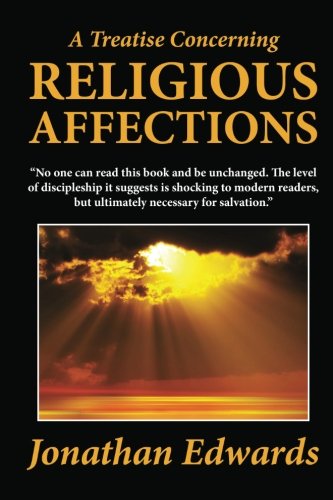
33. A Treatise Concerning Religious Affections

From Wikipedia: 


Edwards wrote the Treatise to explain how true conversion to Christianity occurs. Edwards describes how emotion and intellect both play a role, but "converting grace" is what causes Christians to "awaken" to see that forgiveness is available to all who have faith that Jesus' sacrifice atones for all sins. This salvation is not possible through believers' imperfect good works which are simply evidence of faith, and only possible through Christ's sacrifice which is free to all. Edwards describes the importance of testing new faith and discerning whether it is legitimate. He lays out twelve tests of true conversion, including ways of measuring allegedly fruitful works. He basically concludes that the fruit of the Spirit are the religious affections, love being the chief affection, and that all other fruit (or Christian virtues) flow from this. "Love is the chief of the affections, and as it were the fountain of them." (p.76, Banner of Truth Edition). He further says "for it was not by men's having the gifts of the Spirit (referring to spiritual gifts), but by their having the virtues of the Spirit, that they were called spiritual." (p.127). This is how you can distinguish between carnal men and spiritual men. Carnal men do not produce the fruit of the Spirit, but spiritual men do. So it was with Christ. "All the virtues of the Lamb of God, His humility, patience, meekness, submission, obedience, love and compassion, are exhibited to our view in a manner the most tending to move our affections of any that can be imagined." (p.53)

I had a slow start with this book. I got it for free with Logos Vyrso and put it in their app, but I could never figure out where I left off (cannot figure out bookmarks). Then, I tried to read a free PDF, but I have the hardest time reading things on the computer. Then, I tried listening to a free audio version that was absolutely TERRIBLE. (I am not even going to give the link for it.)

I finally broke down and bought the 99 cent Amazon version. I had not done that before because I already had the LOGOS version, and the Amazon reviews said it had a lot of typos, but the typos were pretty infrequent and not distracting, and it was only 99 cents! I like the Kindle version because I can go back and forth between reading it on my Kindle OR my iPhone (and all the bookmarks sync) and listening to it. 

The principles are simple, and they line up with what I am writing about in the Bible Book Club as I work through the epistles: love and humility are most important and true religious affections manifest in outward behavior. I am in James right now, and this book punctuates that faith without works is dead!  He also makes a case that religious affections involve both reason and emotion.  He seems pretty anti-charismatic and very anti-Catholic, but that was common in that time in history)

I liked it, but I want to write a book that says:

READ YOUR BIBLE

(Three word book)

Then you can get all that Edwards said straight from God's heart to yours! 

Saturday, May 18, 2013

32. Doctor Johnson's Prayers

This was recommended as one of the three books to read about Doctor Samuel Johnson. He was a very godly man and wrote out many prayers that were made into this little book. 

I always find it awkward to read other people's prayers though. 


Tuesday, May 14, 2013

31. The Temple by George Herbert

Here was a man who seemed to me to excel all the authors I had read in conveying the very quality of life as we live it from moment to moment, but the wretched fellow, instead of doing it all directly, insisted on mediating it through 
what I still would have called the "Christian mythology."  The upshot of it all could nearly be expressed, "Christians 
are wrong, but all the rest are bores."
-C. S. Lewis


One does not need to buy this book and can read The Temple HERE

LOVE (III)
by George Herbert


Love bade me welcome, yet my soul drew back,
        Guilty of dust and sin.
But quick-ey'd Love, observing me grow slack
        From my first entrance in,
Drew nearer to me, sweetly questioning
        If I lack'd anything.

"A guest," I answer'd, "worthy to be here";
        Love said, "You shall be he."
"I, the unkind, the ungrateful? ah my dear,
        I cannot look on thee."
Love took my hand and smiling did reply,
        "Who made the eyes but I?"

"Truth, Lord, but I have marr'd them; let my shame
        Go where it doth deserve."
"And know you not," says Love, "who bore the blame?"
        "My dear, then I will serve."
"You must sit down," says Love, "and taste my meat."
        So I did sit and eat.

Notice the way he wrote this with the BOLD!


COLOSSIANS III. 3.OUR LIFE IS HID WITH CHRIST IN GOD.
MY words and thoughts do both express this notion, 
That LIFE hath with the sun a double motion. 
The first IS straight, and our diurnal friend : 
The other HID, and doth obliquely bend. 
One life is wrapt IN flesh, and tends to earth ; 
The other winds t'wards HIM whose happy birth 
Taught me to live here so THAT still one eye 
Should aim and shoot at that which IS on high— 
Quitting with daily labour all MY pleasure, 
To gain at harvest an eternal TREASURE. 


(from: http://www.luminarium.org/sevenlit/herbert/colossians.htm)
I loved these poems. They are not always the easy to understand, but they are well worth it! Two thumbs UP!

Sunday, May 12, 2013

30. Rasselas by Samuel Johnson

File:Rasselas 1004.jpg"Do not suffer life to stagnate; it will grow muddy for want of motion: commit yourself again to the current of the world."


In this enchanting fable (subtitled The Choice of Life), Rasselas and his retinue burrow their way out of the totalitarian paradise of the Happy Valley in search of that triad of eighteenth-century aspiration – life, liberty and happiness.According to that quirky authority, James Boswell, Johnson penned his only work of prose fiction in a handful of days to cover the cost of his mother’s funeral. The stylistic elegance of the book and its wide-ranging philosophical concerns give no hint of haste or superficiality. Among other still burning issues Johnson’s characters pursue questions of education, colonialism, the nature of the soul and even climate alteration. Johnson’s profoundest concern, however, is with the alternating attractions of solitude and social participation, seen not only as the ultimate life-choice but as the arena in which are played out the deepest fears of the individual: “Of the uncertainties of our present state, the most dreadful and alarming is the uncertain continuance of Reason.” (Summary by Martin Geeson at www.librivox.org)

Martin Geeson is also the wonderful Englishman who narrated this. He is awesome! 

Friday, May 10, 2013

28. A Life of Johnson by James Boswell


Since this particular chapter in Invitation to the Classics involves reading Johnson's Selected Essays, Prayers, and Rasselas, I decided to opt for the greatly abridged version of this book by NAXOS audio rather than the full 1300+ page unabridged version. I did look at the unabridged in the library and followed along as I listened for a good chunk of it. 

I really enjoyed the narrator, Bill Hartman, with his deep Scottish brogue. Since my 2nd great grandparents immigrated from Scotland to Pennsylvania in 1864, it was special for me!

Samuel Johnson (1709-1784) was THE man of literature in the mid-eighteenth-century England. He wrote moral essays, poetry and prayers (Johnson was a devout Anglican). He is probably most famously known for publishing a Dictionary of the English Language  or sometimes published as Johnson's Dictionary (1755) that stood as the authoritative dictionary until the Oxford English Dictionary came 150 years later.

Johnson would not have been SO well-known had it not been for the biography by James Boswell (1740-1795). Boswell sort of had a "man-crush" on  Johnson. I thought their first conversation was funny:

[Boswell:] "Mr. Johnson, I do indeed come from Scotland, but I cannot help it."
[Johnson:] "That, Sir, I find, is what a very great many of your countrymen cannot help."[3] 

We have Johnson to thank for the familiar "...hell is paved with good intentions," and "Patriotism is the last refuge of a scoundrel." 

27. The Twilight of the Idols by Friedrich Nietzsche


I read Ecce Homo for my Well-Educated Mind list, and I could have never read Nietzsche again but for the Invitation to the Classics list (five more to go, and I am DONE with classics lists!).  

Actually, I found this work more accessible than Ecco Homo, but it is Nietzsche, and he is an arrogant, surly philosopher. He "sees himself as a preeminent interpreter to articulate the new meaning of the self, nature, society, and God" (Invitation to the Classics, p.300). I do not care for his ideas, but his works, especially this one, are like a bitter pill that needs to be swallowed if we are to understand this nineteenth-century philosopher's influence on twentieth-century thought. In this work, he attempts to destroy and expose the "idols" of Western thought and culture. He takes aim at everyone, especially Christianity. "Christianity, which despised the body, has been the greatest misfortune of humanity so far" (p.41).

Considering Nietzsche's beliefs about God and truth, we can easily wonder why a Christian would bother to read him. Quite simply, Twilight of the Idols is important for the Christian reader because of the powerful -- however partial -- nature of the truth that it does tell. It poses various questions: (1) If Nietzsche is in the business of breaking idols, does he not have at least something in common with the Judeo-Christian tradition? 
(2) In biblical history and the history of the Christian church, has it not been repeatedly necessary for prophetic voices to rise up to break the idols that falsely claim the allegiance of believers? For instance, in Twilight of the Idols Nietzsche criticizes the English Victorian novelist George Eliot for believing that once she gets "rid of the God," she can still "cling all the more firmly to Christian morality." A Christian critic of culture might well sympathize with Nietzsche's attack on the modern idolatry of the self. It is Nietzsche who says in this passage on Eliot that "Christianity is a system, a consistently thought out and complete view of things. If one breaks out of it . . . the belief in God, one thereby breaks the whole thing to pieces." Nietzsche argues that there are no moral sources within the self. "Christian morality is a command; . . . it possesses truth only if God is truth." (Invitation to the Classics, p. 302)

Funny because this is the part I listened to this morning, and that was about the only thing I agreed with in the whole book! LOL!

The whole time I listened to the Librivox recording, I thought to myself, "And how is that working for you Mr. Nietzsche?"  Not very well apparently. He went insane shortly after this book's publication (but some postulate that his madness was brought on by physical illness). I think he knew about Christianity as the son of a Lutheran pastor, but I do not think he really understood a relationship with God. I also wonder if he had "father issues" because that is often an indicator of a disconnect with God. The fact that he was "devoutly religious" in childhood made me mourn this man's life and death. I wonder where his soul is now?


Fun fact about one of his quotes: 

Cultural Impact

Nietzsche's original line, "From life's school of war: what does not kill me makes me stronger" has been referenced many times. G. Gordon Liddy, former assistant to President Richard Nixon, paraphrased it as "That which does not kill us makes us stronger". In that phrasing, it has appeared in many places including the opening of the film Conan the Barbarian(1982),[9]Kanye West's song Stronger (2007) and Kelly Clarkson's song Stronger (What Doesn't Kill You) (2012).[10]

Monday, May 06, 2013

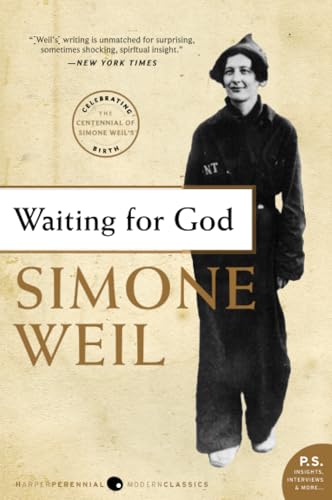
26. Waiting for God by Simone Weil

Sheer and utter brilliance and beauty! The letters to the priest were OK, but her essay on "The Love of God and Affliction" took my breathe away.  The whole essay is HERE. It is well-worth your time to read it. Then you can say you read one of the great 20th century philosophers! 

"All that man vainly desires here below is perfectly realized in God. We have all those impossible desires within us as a mark of our destination, and they are good for us when we no longer hope to accomplish them." (p. 74)

Invitation to the Classics says, "Despite Weil's preoccupation with the political and social nightmare of the Spanish Civil War and World War II, she still . . . focused on a God who superseded the pain and chaos of this world" (p. 345). 

She was a French Jew from an agnostic home writing during World War II. She was definitely an unconventional believer, but she "gets God" and is often called a "saint for the churchless." She is definitely unconventional, but she is brilliant. I heartily recommend her!
God created through love and for love. God did not create anything except love itself, and the means to love. He created love in all its forms. He created beings capable of love from all possible distances. Because no other could do it, he himself went to the greatest possible distance, the infinite distance. This infinite distance between God and God, this supreme tearing apart, this agony beyond all others, this marvel of love is the crucifixion.
I read much of this book while waiting in the Burbank Airport for a flight to Portland. I wish I had bought the book. I did not write down all the wonderful quotes and cannot find many of them as I write this review. It would have been so much easier to underline, but I cannot deface a library book (as much as I was tempted). 

Waiting for God will waiting for a plane!
I especially like that she found that by reciting the devotional poetry of George Herbert, she could transcend the physical pain of her migraine headaches as she contemplated the Christian mysteries. I am right in the middle of reading Herbert's poetry!!! I love it when my worlds collide like that!

On one occasion she was reciting the poem "Love (3)": "Love bademe welcome, but my soul drew back/Guilty of dust and sin. . . ." In doing so she experienced an encounter so overwhelming in its otherness that she became convinced that "Christ came down and took possession of me . . . in this sudden possession of me by Christ, neither my senses nor my imagination had any part; I only felt in the midst of my suffering the presence of a love, like that which one can read in the smile of a beloved face." (Invitation to the Classics, p.346) 
I love how God comes to those who diligently seek Him. Beautiful book.

One more thing, she loved what fiction and art could do in our life, and I heartily agree:

This is something else which has the power to awaken us to the truth. It is the work of writers of genius. They give us, in the guise of fiction, something equivalent to the actual density of the real, that density which life offers us every day but which we are unable to grasp because we are amusing ourselves with lies. 
Art is the symbol of the two noblest human efforts: to construct and to refrain from destruction.
One more favorite quote (there are TOO many to write out in this blog post):


Random quotes I found on the web: http://www.brainyquote.com/quotes/authors/s/simone_weil.html


91% Through My Invitation to the Classics List!


  1. 1633 The Temple – Herbert (1/2 way through)
  2. 1746 A Treatise Concerning Religious Affections – Edwards (started)
  3. 1759 Essays and Rasselas – Johnson
  4. 1791 The Life of Samuel Johnson, LL.D. – Boswell
  5. 1843 Fear and Trembling - Kierkegaard
  6. 1888 Twilight of the Idols - Nietzsche
  7. 1942 Go Down, Moses - Faulkner
I am so close to my goal, but the thought of one more Faulkner and one more Nietzche . . . well.  No! It doesn't depress me. I am a fighter. I am a finisher. I am going to go for it!!!

The other ones are hard to get through but in a good sort of way. Samuel Johnson is big one on everyone's radar. You do not realize how influential he was until you know his name. Then you hear him quoted and mentioned. Herbert and Edwards are spiritual, and I always love that. Keirkegaard is brilliant but tough. I love brilliance, even though it makes my brain hurt in the light of it.

So, HOME STRETCH, HERE WE COME!


Monday, April 22, 2013

25. Four Quartets by T.S. Eliot

I read "The Waste Land" for my Well-Educated Mind list, but that was written before Eliot converted to faith in June 1927 and was based on his very unhappy first marriage. Prior to conversion, he was a "modernist poet."
Modernism assumes we live in a post-Christian era. And in the more pessimistic form, which Eliot helped inaugurate, its adherents find few ordering principles for modern life, adopt a general mood of bleak disillusionment, and attack the fallacies and frailties of the day. (Invitation to the Classics, p. 319) 
Four Quartets are probably his most famous poems after he converted. 
Four Quartets are four interlinked meditations with the common theme being man's relationship with time, the universe, and the divine. In describing his understanding of the divine within the poems, Eliot blends his Anglo-Catholicism with mystical, philosophical and poetic works from both Eastern and Western religious and cultural traditions, with references to the Bhagavad-Gita and the Pre-Socratics as well as St. John of the Cross and Julian of Norwich.
http://en.wikipedia.org/wiki/Four_Quartets 

The "Four Quartets" are unified in their focus on four elements: air ("Burnt Norton"), earth ("East Coker"), water ("Dry Salvages"), and fire ("Little Gidding"). The common theme is summed up as "redeem the time" (Invitation to the Classics, p.320). "Throughout the poetry Eliot speculates on both the nature of the present age and the impact of the eternal on the present" (p. 320). 

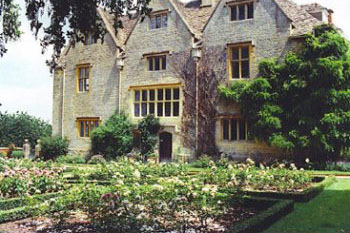
Here is Burnt Norton in the English Cotswalds (where we want to go on our 25th wedding anniversary!):

Burnt Norton

"Time past and time future
What might have been and what has been
Point to one end, which is always present."

from: "Burnt Norton"


Here is East Coker a village in Somerset, England:


"Our only health is the disease
If we obey the dying nurse
Whose constant care is not to please
But to remind of our, and Adam's curse,
And that, to be restored, our sickness must grow worse."  
from: "East Coker" 


My favorite was "Dry Salvages" that refers to the rocks off the northeast coast of 
Cape Ann, Massachusetts where Eliot spent vacations during his childhood. 


http://www.captainshouse.com/salvages.html
It is interesting to note that he wrote this poem toward the end of 1940 when London was experiencing air raids during World War II! What a pleasant escape! 
The poem can be described as being about water and hope. It begins with images of the sea, water, and of Eliot's past; this water later becomes a metaphor for life and how humans act. This transitions into an image of a ringing bell and a discussion on time and prayer. Images of men drowning dominate the section before leading into how science and ideas on evolution separate mankind from properly understanding the past. This ends with Krishna stating that the divine will, and not future benefits or rewards, matters. The fourth section is a prayer to the Virgin Mary for fishermen, sailors, and the drowned.

The end of The Dry Salvages starts with a discussion about how people attempt to see the future through various superstitious means. Then the narrator tries to convince the reader that resignation about death is necessary. However, such resignation should be viewed as pushing the self towards redemption and the eternal life in the next world. By acting properly, one is able to overcome life and move towards the next world. (
http://www.captainshouse.com/salvages.html)

I was having a hard day and wanted to run away to the beach where I often go and spend days of prayer. For that reason, these lines spoke to me: 
The river is within us, the sea is all about us;
The sea is the land's edge also, the granite,
Into which it reaches, the beaches where it tosses
Its hints of earlier and other creation:
The starfish, the horseshoe crab, the whale's backbone;
The pools where it offers to our curiosity
The more delicate algae and the sea anemone.
It tosses up our losses, the torn seine,
The shattered lobsterpot, the broken oar
And the gear of foreign dead men. The sea has many voices,
Many gods and many voices. (From "Dry Salvages") 
SparkNotes.com says:
This quartet departs from the pessimism and human ruins of the other three to consider humanity as a whole, as an entity with a unified subconscious and memory that produce mythic structures. Humanity is, thus, placed on a level with the natural world as something with a history and with cycles of rebirth and renewal.

Being that I am a non-pessimistic person, it figures I would like the most hopeful of them all.

Invitation to the Classics says,
The ceaseless flow of water figures the ceaseless flow of humanity's aspirations to know the divine in the different ways and cultures. All such efforts -- "hints and guesses" -- point toward the fulfillment in Christ, a truth that Eliot suggests in the poem but deliberately understates. (p.320)

But he makes it abundantly clear in the last poem, "Little Gidding" where the narrator makes a pilgrimage to the chapel of Little Gidding in Huntingdonshire. From the beginning this points to communion with God. This can happen anywhere, at anytime though. It comes through prayer and the work of the Holy Spirit. The element here is fire which hearkens to the day of Pentecost (May 19, 2013) and contrasts with the "fires of the age" with allude to the bombings in London during World War II where Eliot was a fire warden. It also alludes to the desire for the things of the flesh. 

"The only hope, or else despair
Lies in the choice of pyre or pyre --
To be redeemed from fire by fire." 
 It seems that I needed renewal this morning, and T.S. Eliot did the trick! Who knew?

"What we call the beginning is often the end
And to make and end is to make a beginning.
The end is where we start from."


"We shall not cease from exploration
And the end of all our exploring
Will be to arrive where we started
And know the place for the first time."


Here is the chapel in Little Gidding:

File:St John's Church, Little Gidding.jpg

Monday, April 15, 2013

22. The Federalist by Hamilton, Madison, and Jay


I am strange. I never knew that political thought could be so fascinating to me, but it is. Between the Well-Educated Mind and Invitation to the Classics, I have been exposed to some of the classics of political thought!  


Here is a brief summary of what they are all about:

The Federalist Papers are a series of 85 essays that argue for the adoption of the United States Constitution, to replace the Articles of Confederation. 
Published in three New York newspapers between October 1787 and May 1788, the essays then appeared in newspapers across the nation. 
They were composed by three different authors:  Alexander Hamilton, John Jay, and James Madison, all under the pseudonym Publius. 
Today the Federalist Papers serve as a primary source for interpretation of the United States Constitution. 
As the American experiment unfolds, it is worthwhile to remember how it began. 
I obtained this summary from an excellent website with FREE Audio © Michael Scherer of all the essays:  http://michaelschereraudio.com/?page_id=1188
These were written to persuade the New York state convention to ratify the US Constitution. 
The letters soon became known as the authoritative source for understanding what Thomas Jefferson called "the genuine meaning" of the Constitution. Further, George Washington declared that The Federalist would "merit the notice of posterity" because the letters so ably discuss the principles of free government. (Invitation to the Classics, p.199)
It certainly convinced me that our Constitution is wonderful!

I listened to the FREE audio and read the FREE Kindle version from Amazon. I was over halfway through reading all of them when I realized that the Invitation to the Classics says:
Historian Clinton Rossiter states that "the common consent of learned opinion" holds the following to be the most important: 1, 2, 6, 9, 10, 14, 15, 16, 23, 37, 39, 47, 48, 49, 51, 62, 63, 70, 78, 84, and 85. This listing may proved to be a helpful guide for those who lack the time or endurance to read the text from cover. Madison's Number 10 and 51 and Hamilton's Number 78 should certaintly be read and appreciated. (p.202)
I read 1-44, but decided to go with the remaining suggested ones starting at 47. I liked focusing on the more important ones, and they were fascinating! These men were brilliant with amazing foresight! I think the US Constitution WORKS! And we have these men to thank for it!
The accumulation of all powers, legislative, executive, and judiciary, in the same hands, whether of one, a few, or many, and whether hereditary, self-appointed, elective, may justly be pronounced the very definition of tyranny. (Number 47)
The balance of powers with its system of checks and balances works!
A NATION without a NATIONAL GOVERNMENT, is in my view, an awful spectacle. The establishment of a Constitution, in time of profound peace, by voluntary consent of a whole people, is a PRODIGY, to the completion of which I look forward with trembling anxiety. (Number 85)
I think these men might CRINGE at what has happened to the size of our Federal government and the mess of our tax code though! 

A good book to finish on TAX DAY 2013.

God Bless America
Land that I LOVE!


With: Reimagining the Way We Relate to God

I am doing a simple book review because for some reason, Google has given a "warning" for my last two posts on this book, and I st...