 This was the only classic I read in high school, and I did not like it or get it. I read it again about 9 years ago, and I liked it. This time I proclaim that there is a reason why this is considered the "great American novel"! I know it is not very happy, but his writing is lyrical. The thoughts are profound and deep.
Showing posts with label American Literature. Show all posts
Showing posts with label American Literature. Show all posts
Thursday, September 12, 2013
55. The Great Gatsby by F. Scott Fitzgeral
This was the only classic I read in high school, and I did not like it or get it. I read it again about 9 years ago, and I liked it. This time I proclaim that there is a reason why this is considered the "great American novel"! I know it is not very happy, but his writing is lyrical. The thoughts are profound and deep.

Thursday, May 30, 2013
35. Go Down, Moses by William Faulkner
 Swearing off Faulkner forever?
Ok, maybe Faulkner has finally won over my heart, but I have a sort of love/hate relationship with the guy (probably like his wife did).
He is a very good crafter of words. Writers change the course of history, and he certainly should be applauded for just understanding the absolutely stupidity of slavery and of treating black people as less than human. How could a Christian think they could twist Scripture to treat people like chattel? I just don't get it, but Faulkner did. My favorite Civil War historian, Shelby Foote, once said, "Faulkner, to me, was one of the great communicators of sensation." That is a perfect way to put it! His writing created sensation and made people think! He was so ahead of his time, and that is what probably won him the Nobel Prize for Literature and two Pulitzers. Here is an excerpt of his Nobel acceptance speech:
I believe that man will not merely endure: he will prevail. He is immortal, not because he alone among creatures has an inexhaustible voice, but because he has a soul, a spirit capable of compassion and sacrifice and endurance. The poet's, the writer's, duty is to write about these things. It is his privilege to help man endure by lifting his heart, by reminding him of the courage and honor and hope and pride and compassion and pity and sacrifice which have been the glory of his past. The poet's voice need not merely be the record of man, it can be one of the props, the pillars to help him endure and prevail. (Read or listen to speech HERE)I wonder how he was so ahead of his time. Was it the influence of his "Mammy" to whom he dedicated Go Down, Moses?
As much as I respect his brilliance as a writer, he is so depressing and hopeless. The "Life's a bitch and then you die" philosophy of the American Modernist Movement (think Hemingway, Stein, Fitzgerald) is not really my cup of tea. Neither is Southern Gothic fiction. So, that is two strikes against him. Plus, his personal life was such a terrible mess (Think Hemingway, Fitzgerald, and Stein again). What is it about these turn of the century American authors? Brilliant but messed up!
There is an excellent video about him: HERE
This novel was better than As I Lay Dying and The Sound and the Fury, and it is equal to Light in August (Remember when Oprah had you read three Faulkner's in the summer of 2005? I gave up after The Sound and Fury only to finally read Light in August last summer - and liked it! Do yourself a favor and start with LIA and the resources HERE.). All that said, this is probably my last Faulkner (We will pause for a moment of silence.).
Go Down, Moses is a series of interwoven stories about the descendants of Lucius Quintus Carothers McCaslin (1772 - 1837). There are many characters and this makes it confusing. I found this genealogy very helpful as I read:
McCaslin Genealogy (I had to look up what "miscegenation" meant)
Sparknotes.com was also quite helpful.
The title is based on the American negro spiritual:
- When Israel was in Egypt's land: Let my people go,
- Oppress'd so hard they could not stand, Let my People go.
- Go down, Moses,
- Way down in Egypt's land,
- Tell old Pharaoh,
- Let my people go.
In the song "Israel" represents the African-American slaves while "Egypt" and "Pharaoh" represent the slavemaster.
Tuesday, January 08, 2013
2. Dandelion Wine by Ray Bradbury


Bradbury is a beautiful writer, but I was never really "grabbed" by this book. It is Bradbury's "gathering of dandelions" over the years in Illinois. Written in 1959, they are fictional short stories that are loosely connected together with fantastical elements and related to his growing up in Waukegan, Illinois in 1928. I don't want to discourage anyone from reading it, but because it lacked a plot, it just didn't drive me to keep reading it like many books with a good story. In some ways, it is like Dubliners, but Dubliners was so much more interesting to me!
Here is a brief synopsis:
Although Bradbury is primarily known as a science fiction writer, Dandelion Wine is not a science fiction book. However, it does contain elements of the dark side of human nature and the fantastical magic that permeates the book makes it different from other novels. In his introduction, Bradbury comments that a reviewer once took him to task for not describing Waukegan (Green Town) as an ugly and sometimes depressing town. Bradbury's response is that he was writing from the perspective of a twelve-year-old boy. To children, everything can be magical, and that is the sentiment that Bradbury attempts to bring across in his novel. Furthermore, Bradbury insists that his novel is real and true because he says it is. Even if it is not historically accurate, it is the portrayal of a child's summer. Bradbury believes that because that portrayal is his way of writing his own childhood and is steeped in the poignant memories of his past, it is therefore real. (http://www.sparknotes.com/lit/dandelion/context.html)
Here is a better review by someone who REALLY loves the book and has thought deeply about it. It helped me appreciate the book much more!
http://www.librarything.com/work/2460/reviews/74592639
Here is the best part of her analysis:
To me, the overarching intent of the book is to remind all us adults that:
* Being alive means maintaining a balance between Discoveries & Revelations and Ceremonies & Rites. Though the latter are important, binding us to our family & our community, our future & our past, it is Discoveries & Revelations that make us think, experience, change, and grow.
* Being alive means living in the present. Even if this means giving away the tokens of a beloved past, as happens in one particularly poignant tale.
* Being alive means being connected with the world - with family, neighbors, your community, the earth. It's no coincidence that the mysterious murderer haunting Douglas Spaulding's Childhood is called The Lonely One.
* Being alive means being able to experience happiness ... not only understanding the nature of happiness, but possessing the wisdom not to let yourself be tricked into pursuing something that can't/won't make you happy. (Dorritt, June 20, 2012)
* Being alive means recognizing the presence of magic in our everyday lives. Because magic is out there ... in the spring of a new pair of tennis shoes, in the mysteries of love, in the essence of Dandelion Wine.
Sunday, November 04, 2012
52 in 52 Week 45: A Separate Peace by John Knowles.
 This was on my "100 Great Books List." Ten pages into the novel, I remember I had read it before. I had a discussion with someone telling them that I thought I had read it and told them a little of what it was about, and they said, "Oh that is not that book." So, I believed them and included it on my unread list. I should have looked it up. A short synopsis would have reminded me. I wonder why that person was so adamant about it. I do not even remember who it was, but they were so convincing, I questioned myself. Funny because I had someone adamant about something else recently, but this time I didn't believe them and looked it up. I need to not be so easily convinced. People love to do that sometimes in an effort to make you feel small. I made a choice to reread it anyway, and I am so glad that I did! I have warm feelings this morning because of it. A "separate peace" was hard to find, but I think I have found it.
 In my recollection, this was my first "pleasure reading" novel after high school in the summer of 1977. I was free to read anything, and I read as I lay in the big, brass bed of the family I was staying with after my parents moved away from my hometown. I wonder how much of it went over my head being that the main characters were about the same age as I was in 1977. It is a coming-of-age novel. I had not learned about "the war within" but was embarking on that journey as I neared my early 20's where finding the equilibrium of "a separate peace" seemed impossible for me to find. That is why it was good to reread this book in retrospect of my life where that "separate peace" is always there now.
The writing in this book is really simple and beautiful. The backdrop of World War II makes much more sense to me now that I have studied history several times over since then (thank you homeschooling).
"As I said, this was my sarcastic summer.
It was only long after that I recognized sarcasm
as the protest of people who are weak." (p. 29)
This is my favorite line of the book. I detest sarcasm. Maybe I am not weak. I used to be around a group of cultural Christian that used sarcasm for sport at other people's expense. My husband would often have to walk out of the room because it got so bad. One husband of a dear of mine went overboard. I see now that he was just insecure, and he was still in a delayed stage of development much like the 16-17 year olds of the novel. I think her husband is stuck in a perpetual "sarcastic summer," and because he gets laughs, no one will probably encourage him out of it. I do not hang with them anymore (the book club that connected us all had more sarcastic people that I could not stomach anymore). So, this quote from the book just sums up the problem I have with sarcasm. I feel stuck in high school with people like that. I do not look to people like this for crumbs of spiritual encouragement and find my fellowship with genuine people who do not fall into the mode of sarcasm when they feel insecure. But I digress.
I recommend this coming-of-age novel. It is deep. As it was my first attempt, as a 17 year old who was also coming-of-age, to let literature take me to places I had never gone, I think I missed so much the first time. That is why it was poignant to read it again as I lay on back in another bed 35 years later. It is so deep that one might miss what the book is all about, maybe those people committed to sarcasm as a shield to their insecurity wouldn't get it either.
Two thumbs up for this novel. It holds a special place in my heart now because I have "come-of-age."
Sunday, October 14, 2012
52 in 52 Week 42: A Farewell to Arms by Earnest Hemingway
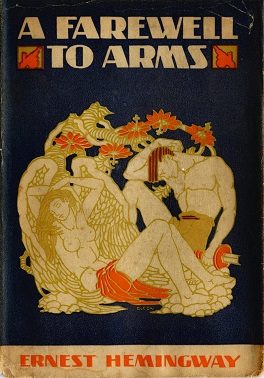 And a FAREWELL TO HEMINGWAY! YAY! After reading FOUR of his books this year because of the 100 Great Books List, I am happy to say FAREWELL!
 I still don't really care for him. I especially realized how much I don't like him because I read his book after the BEAUTIFULLY written book, All the King's Men. Robert Penn Warren was a poet who also wrote prose. Hemingway just seems like a man's man who wrote in such an elementary manner. Plus, the guy just seems like he just doesn't GET anything. Very immature person. Emotionally handicapped IMHO. I don't think I would have cared for Hemingway. His relationships are so shallow and empty. So, there you go.
I also think that he is probably more liked by men. He is just a man's man. My husband loves him, and I have such respect for my husband. So, I guess he is just not my cup of tea. He probably wouldn't have liked Austen either.
I put this right after my review of All Quiet on the Western Front because they are both books written with World War I as the backdrop. Yet, All Quiet is so much more beautifully written and profound! Hemingway fails in my mind, AGAIN!
Sunday, September 09, 2012
52 in 52 Week 37: The Jungle by Upton Sinclair
 Awesome and brilliant. I didn't realize it was a novel. From some reason, I thought this was a non-fiction book about the meat packing industry in America. It is SO much more. He writes so wonderfully!
Do not get me wrong. This is a propaganda novel for socialism! The last part is very "preachy" on that score, but it is still brilliant.
How strange that I would be reading it at the same time I have been doing genealogy research on the Swedish side of my family. My grandparents came as single people in 1923, met, and got married in Chicago, Illinois. What guts. I am sure they experienced great hardship but they ended up millionnaires in the end.
Sorry Upton, Capitalism rules!
Sunday, June 03, 2012
52 in 52 Week 24 :For Whom the Bell Tolls by Ernest Hemingway

No man is an island,
Entire of itself.
Each is a piece of the continent,
A part of the main.
If a clod be washed away by the sea,
Europe is the less.
As well as if a promontory were.
As well as if a manor of thine own
Or of thine friend's were.
Each man's death diminishes me,
For I am involved in mankind.
Therefore, send not to know
For whom the bell tolls,
It tolls for thee.
Entire of itself.
Each is a piece of the continent,
A part of the main.
If a clod be washed away by the sea,
Europe is the less.
As well as if a promontory were.
As well as if a manor of thine own
Or of thine friend's were.
Each man's death diminishes me,
For I am involved in mankind.
Therefore, send not to know
For whom the bell tolls,
It tolls for thee.
(1624 Meditation 17, from Devotions Upon Emergent Occasions)
Before I start my review, let me refer you to a fascinating NPR radio report by Susan Stamberg about how fierce political opponents, Barack Obama and John McCain, relate with the main character, Robert Jordan HERE.
First off, let me say that I have always avoided Hemingway like the plague, but he is one of my husband's favorite authors. Also, four out of Hemingway's seven novels are on my list of "100 Great Books"! Can you believe that?
So this is my first foray. The tipping point toward reading came when I saw Midnight in Paris, and my husband laughed through all the lines of the Hemingway character, and I realized that he was the only author in the movie that I had not read (If you love art and literature, you HAVE to see Midnight in Paris. It is so fun!). Now that I have read through my first Hemingway, I know that Woody Allen TOTALLY pegged him in this movie. I need to see it again now that I have finally read him!
 |
| Francisco Franco ruled Spain from April 1939 - November 1975 |
I like books that make me think of history and war. Hemingway had an agenda. War stinks ("a bitchery" as one of the characters in the book says toward the end). I agree. The story was very slow moving, but I have to admit that Hemingway finally captivated me about 1/2 way through the almost 500 page book. I had been listening to it on audiobook, but there was something about seeing Hemingway's words that made me appreciate him for the craftsman that he truly was.
When I was stuck on that first half, I checked out the 1943 movie version with Gary Cooper and Ingrid Bergman (really, a blonde-haired, blue eyed Swede playing a Spaniard?). A visual picture sometimes gets me through a book. By the way, this is the only movie adaptation that Hemingway liked, and he loved Gary Cooper, his friend, playing the role of Robert Jordan.
Prior to the halfway point, I would have said it was pretty boring. Wondering if anyone else thought Hemingway boring, I found a fascinating article by Googling, "Is Hemingway Boring?" Read it! It is great (It has a few spelling errors, but don't let that deter you.). My husband tells me that Hemingway was the first of his kind. How he wrote was so ground-breaking that he won the Pulitzer Prize for literature. Today's reader might not appreciate this.
As I read it, I did wonder why is it that so many Twentieth Century authors wrote so brilliantly when they were drunk or high on drugs? I feel like it is like a "Photoshop for authors" because it enhanced their writing like Photoshop enhances photos. It is sort of like cheating.
Why were so many of them such troubled souls? Many of them died tragic deaths with suicide or the slow suicide from the substances they abused. Hemingway's suicide was related to all the health problems related to hard living, but it was also because he was severely depressed after the death of his friend, Gary Cooper (star of For Whom the Bell Tolls), from cancer two months earlier.
All that said, I ended up loving this story. I couldn't put it down (and even brought it to our church's annual business meeting and read it during less interesting points in the evening. LOL!).
The movie, like the book, is incredibly slow in the beginning, but it picks up in the second half and leaves you quite moved and contemplative in the end. Their love story was mesmerizing (and much cleaner in the movie than in the book!).
Friday, March 30, 2012
52 in 52 Week 13: The Pearl by John Steinbeck
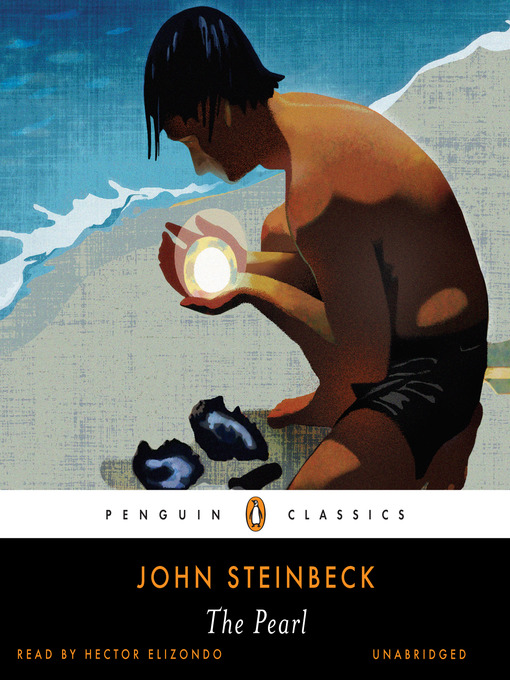 I had tea with my friend, Sharon, a couple of weeks ago, and her son, home on break from Annapolis Naval Academy, sat down with us to discuss classical novels. He had said he didn't like Pride and Prejudice a few years earlier, but he finally sat down and loved it. I like that he tried again when he was a few years older.
He also said, "I had to read The Pearl in high school, and that story is just stupid." I told him I had it on hold at the digital library. It made me wonder if he would like this one too if he gave it a try at an older age.
I did not think it was stupid. Yes, it is another depressing, American novel of the 20th century, but it is profound. I love Steinbeck's writing. He is a wonderful craftsman of a story. This is a simple, symbolic short novel set in the early 1940's. It tells of what happens to a poor family that finds a great pearl. The main themes are anti-materialism, knowing one's place in society, greed, illusion versus reality, and the wisdom that comes out of difficulty.
The major question is: "Can money buy you peace, love, and harmony in life?" It is interesting to look at this question in light of the lottery being 500 million today. There is a hot discussion on my girlfriend's Facebook page about what people would do with the money. Yesterday, I watched the new commentators banter about it. I didn't know that one of the mega winners was kidnapped and murdered by his sister-in-law. WOW!
The timing of this novel is perfect for this discussion!
Hector Elizondo's narration is perfect. It is a 2-3 hour listening feast.
Tuesday, March 06, 2012
52 in 52 Week 10: Why Read Moby-Dick? by Nathaniel Philbrick
 I loved this book! I picked it up after reading a review by another member of 52 Books in 52 Weeks challenge. I listened to THIS NPR interview with Robert Siegel and decided to read the book!
This book met my expectations and beyond. It was so fascinating to read after having read Moby Dick in September 2004 and feeling much like Linda Holmes in the "I Will If You Will Book Club" who wrote after reading Moby-Dick,
"Book club vice-president Marc Hirsh and I finished the book in June of that year and declared it a great lesson in 'how to pursue a pointless battle to its bitter, violent, inevitable end.' By which we meant, in part, reading the book."
My joke has always been that it was 100 pages of plot and 500 pages of whaling encylopedia! Reading Philbrick's book helped me understand the method behind Melville's madness.
I especially liked reading about the relationship between Nathaniel Hawthorne and Herman Melville. There is personal correspondence between the two that helps you understand that Hawthorne was the one who inspired Melville to add a plot to what was more a whaling encyclopedia. Even though I didn't appreciate the whaling encyclopedia part, Philbrick convinced me it had value.
Here is a bit of the transcript for the interview with the author:
SIEGEL: And first, the answer to the question of your title. This book runs hundreds of pages; life is short. Why read 'Moby-Dick'?
PHILBRICK: Read "Moby-Dick" because I think it's as close to being our American Bible as we have. It's just full of great wisdom. But it also is just an amazing read. The level of the language is like none other. And it's a book I keep dipping into on a regular basis - almost on a daily basis.
SIEGEL: As you describe it, Herman Melville was already a successful writer when he wrote a novel about whaling - that would be more of an adventure story, I guess, than what it turned into - at a time when Americans actually associated adventure more with the Western frontier than with the seas. And he scrapped this book, and he added all of the incredibly rich undertones and overtones that make it "Moby-Dick." Why? What happened?
PHILBRICK: Well, he met Nathaniel Hawthorne and read some of his stories, and it was Hawthorne's power of blackness that forever changed Melville. Melville realized what he wanted to do with this novel was entirely different from his original aim. And he completely reinvented the book and invented Ahab, and made it the classic it is today.
SIEGEL: Hawthorne is central here, but you also write about Melville's midlife encounter with the plays of Shakespeare, and his ambition to outdo Shakespeare.
PHILBRICK: Yeah. Well, Melville came to Shakespeare quite late, which I think proves it's best to come to books like "Moby-Dick" and to Shakespeare after we've had some life experience. And reading Shakespeare just infused Melville's language, brought it to a level that is just unapproachable. And this combination of meeting Hawthorne, but having Shakespeare as a new launching pad, made for an incredible combination that made "Moby-Dick" possible.
SIEGEL: And you observe that it was characters like Iago in "Othello," complex characters that Melville really engaged with when he read Shakespeare.
PHILBRICK: Yeah, and they're all over "Moby-Dick." But what Melville did is, he applied it to his own experiences whaling and also with what was going on in America, with the Civil War approaching. And so it made this incredible stew of influences that made it a book that really will be relevant in all times.
Isn't that funny about Shakespeare, especially since I have just read through so many of the plays that He mentions in this book!
I totally agree with the bolded part of Philbrick's interview about coming to these works later in life, after life experiences. Here is the quote from the book regarding that:
I totally agree with the bolded part of Philbrick's interview about coming to these works later in life, after life experiences. Here is the quote from the book regarding that:
Melville's example demonstrates the wisdom of waiting to read the classics. Coming to a great book on your own after accumulated essential life experiences can make all the difference. For Melville, the timing could not have been better, and in the flyleaf of the last volume of his seven-volume set (large print because his eyes were going bad - Carol's addition) of Shakespeare's plays are notes written during the composition of Moby-Dick about Ahab, Pip, and other characters. (p.61)
Reading Moby-Dick, we are in the presence of a writer who spent several impressionable years on a whaleship, internalized everything he saw, and seven or so years later, after internalizing Shakespeare, Hawthorne, the Bible, and much more, found the voice and the method that enabled him to broadcast his youthful experiences into the future. And this, ultimately, is where the great, unmatched potency of Moby-Dick, the novel resides. It comes from an author who not only was there but possessed the capacious and impressionable soul required to appreciate the wonder of what he was seeing. (p. 70)
I have heard so many people say of the classics, "Oh I read that in high school." (Followed by a look that says, "And I don't want to read it again.") I don't think many young people are ready to tackle classics without more life experiences and education that would help them grasp and understand.
Thanks to the post-Sputnik emphasis on math and science of the Southern California educational system in the 60's and 70's, I wasn't forced to read any classics others than The Great Gatsby and Siddhartha. And I think that was a good thing. I didn't start reading the classics until my late 30's when life experiences had allowed me to appreciate them.
Still, I don't even think I was ready to read Moby-Dick at 45. I started reading through the Well-Educated Mind list in August of 2003 (see list of books HERE), and arrived at Moby-Dick in September 2004. I don't think I had the educational background to really understand many of Melville's references. Now, that I have completed the list, I am sure I would understand more.
I have such a new appreciation for Melville because of Philbrick!!!
Another quote about Melville's review of one of Hawthorne's story collections:
At that time, Hawthorne enjoyed a reputation as a mild-mannered recluse penning well-crafted stories about New England's quaint colonial past. This, Melville insisted, was missing the point. Instead of a "harmless" stylist, Hawthorne was an unappreciated genius possessed by "this great power of blackness." Hidden beneath his stories' lapidarian surfaces were truth so profound and disturbing that they ranked with anything written in the English language.More on Hawthorne:
Melville then turned his attention in the review to Shakespeare. "[I]t is those deep far-away things in him," Melville declared, "those occasional flashings-forth of the intuitive Truth, in him; those short, quick probings at the very axis of reality; -- these are the things that make Shakespeare, Shakespeare." Moreover, it was through his "dark characters," such as Hamlet, Lear, and Iago, that Shakespeare "craftily says, or sometimes insinuates the things, which we feel to be so terrifically true, that it were all but madness for any good man, in his own proper character, to utter, or even hint at them!" In writing about Hawthorne, Melville, via Shakespeare, was laying the groundwork for Ahab. (p. 44-45)
The other breakthrough associated with his invention of Ahab was something he clearly got from Hawthorne: a way to put artistic distance between himself and the very thing he most identified with, thus providing a way to write about the darkest and most frightening aspects of human experience. That was why he could write to Hawthorne, "I have written a wicked book, and feel spotless as the lamb." (p.48)Love his chapter on "Poetry" in the Moby-Dick. It is better to listen to the author read this excerpt from the book, but here is what he says:
PHILBRICK: Yeah. This is a passage from Chapter 51. It's called "The Spirit Spout," and picks up with the Pequod just south of St. Helena.
(Reading) While gliding through these latter waves in that one serene and moonlit night, when all the waves rolled by like scrolls of silver and by their soft, suffusing seethings, made what seemed a silvery silence, not a solitude. On such a silent night, a silvery jet was seen far in advance of the white bubbles at the bow. Lit up by the moon, it looked celestial; seemed some plumed and glittering god uprising from the sea.
SIEGEL: Wow, when you read that, I can imagine Melville reading it aloud as he was writing it. It sounds very much like elaborate, spoken prose.
PHILBRICK: It is. And you know, it's iambic pentameter at times. And the level of the writing is truly poetic, and yet he's telling this epic story. And so the combination is really, one that was built for the ages.I could go on and on about this great little book about a BIG book. This author is excellent. I kept reading quotes from the book to my husband last night, and he started reading it!

Sunday, March 04, 2012
52 in 52: Week 10: Of Mice and Men by John Steinbeck
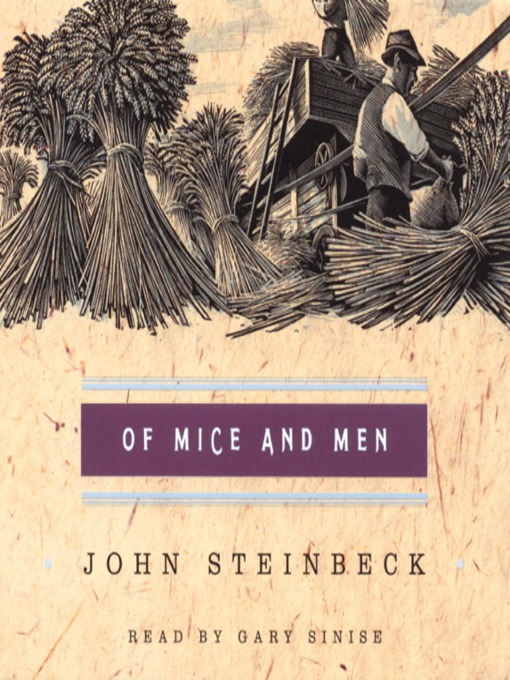 This book's title comes from a Robert Burns poem titled "To a Mouse"
"But, Mousie, thou art no thy lane
In proving foresight may be vain:
The best laid schemes o' mice an' men
Gang aft agley, (Often go awry)
An' lea'e us nought but grief an' pain
For promis'd joy."
This book was based on Steinbeck's own experience as a "bindlestiff" (a hobo who carries a bindle, which is a collection of belongings wrapped in a cloth and tied around a stick). It was published in 1937 during the height of the depression
This is a very "tight" story that involves a very short amount of time. It is set in California. The two main characters are George and Lennie who are farmhands with a dream.
I loved The Grapes of Wrath, and I really loved this novella. It is a "psychological novel." I don't want to spoil it. It is "gritty" though. Just a warning. Steinbeck is a brilliant writer, but he writes about the tough things.
I love this quote from John Steinbeck's journal:
In every bit of honest writing in the world there is a base theme. Try to understand men, if you understand each other you will be kind to each other. Knowing a man well never leads to hate and nearly always leads to love. There are shorter means, many of them. There is writing promoting social change, writing punishing injustice, writing in celebration of heroism, but always that base theme. Try to understand each other.— John Steinbeck in his 1938 journal entry[5]
Sunday, February 19, 2012
52 in 52 Week 8: Ethan Frome by Edith Wharton


Ethan Frome (1911) by Edith Wharton
I read House of Mirth many years ago. I loved it, but most of my book club didn't like her gritty realism. Ethan Frome is the same kind of novel.
Edith Wharton "became known for her psychological examination of characters faced with changes in the moral and social values of middle-class and upper-class society. Her novels and short stories provide numerous expert characterizations of complex men and women" (THE WORLD BOOK ENCYCLOPEDIA © 2007 World Book, Inc.).
This is a "no way out" kind of story. It made me really sad, but Edith Wharton is such an excellent writer! I couldn't put it down. I wanted to know what was going to happen with Ethan, Zeena, and Mattie!
I did not plan to read all these American tragedies for Week 8!
I need a happy novel or at least one with a happy ending. So, I am going back to Britain and Charles Dickens!
52 in 52 Week 8: Daisy Miller by Henry James

Daisy Miller (1879) by Henry James.From Wikipedia:
"Henry James (1843–1916) confronted the Old World-New World dilemma by writing directly about it. Although born in New York City, he spent most of his adult years in England. Many of his novels center on Americans who live in or travel to Europe. With its intricate, highly qualified sentences and dissection of emotional and psychological nuance, James's fiction can be daunting. Among his more accessible works are the novellas Daisy Miller, about an enchanting American girl in Europe, and The Turn of the Screw, an enigmatic ghost story."
I loved Portrait of a Lady by James. I didn't find that daunting but an amazing psychological portrait of an innocent lady and the evil around her.
This is in the realism genre. I do love how James writes, and it is more a cautionary tale with some boundaries of right and wrong which I didn't like in some of the other realistic/naturalistic novels I read this week.
Again, the Portrait of a Lady, is a longer read. So, this is a way to get a little taste of Henry James to see if you like it enough to make a bigger investment!
(I am happy to post my full analysis from Portrait of a Lady here too. One of these days, I will post all of my analyses of The Well-Educated Mind book list here, but that will be a MOMENTOUS task!)
52 in 52 Week 8: The Call of the Wild by Jack London

The Call of the Wild (1903) by Jack London
This book was also from the Naturalism time period (1890's to 1920's):
I read that London converted Nietzsche's "Superman" into animal form in The Call of the Wild" (The Book of Great Books: A Guide to 100 World Classics, p. 104).
I read this more as an adventure novel and hoped it wasn't tragic because of previous ones this week! LOL! I am not a social Darwinist, but I do believe that man has a sinful nature, and eventually it comes out, as we one can observe in many of the human characters in this story. We aren't descended from beasts, but we can act like beasts!
My favorite character was John Thornton. He was my hope that we don't have to beasts even in the hardest situations. :)
Other writers associated with naturalism include Jack London (1876-1916), who often explored the Darwinian contiguity between humans and animals and how the otherwise buried animalistic survival instinct surfaces in extreme circumstances. This is exemplified in THE SEA-WOLF (1904), but is frequently a theme in London's Klondike stories, and distinctions between human and animal behavior were often blurred in his writing, as in THE CALL OF THE WILD (1903) and WHITE FANG (1906). http://www.pbs.org/wnet/americannovel/timeline/naturalism.html
Naturalists (literary determinists) believed that life is determined by environment, heredity, and chance. Jack London's THE CALL OF THE WILD, seven interrelated short stories -- each with its own characters, plot, and climax -- is unified by Buck, a tame dog that reverts to his original primitive state when removed from his comfortable California estate and thrust into the rugged terrain of the Klondike. Told from Buck's point of view, THE CALL OF THE WILD is a naturalistic novel that can be read on several levels.
On the surface, the book tells the story of a dog who learns to survive by reverting to his wild wolf background. Symbolically, the novel can be read as revealing what London himself endured as he climbed out of poverty and obscurity to become affluent and celebrated. In this interpretation, Buck represents London, whose struggle for success taught him cruel lessons about the universe's indifference and brutality. On political and philosophical levels, the novel exemplifies the naturalists' theory of social Darwinism, that only the fittest survive. According to London, buried within each individual is a "ferine strain," a bestial instinct, which has been subdued by civilization but never eliminated.
The novel shows that life is more than just survival;it is also the struggle for mastery: beneath our veneer of civilization, London saw a prehistoric beast who fought and conquered through might and deceit. For this theme, he drew from German philosopher Friedrich Nietzche's dichotomy between masters and those they dominated. London celebrates Buck's fierce battle for dominance, despite its inherent and inescapable savagery. http://www.pbs.org/wnet/americannovel/timeline/thecallofthewild.html
I read that London converted Nietzsche's "Superman" into animal form in The Call of the Wild" (The Book of Great Books: A Guide to 100 World Classics, p. 104).
I read this more as an adventure novel and hoped it wasn't tragic because of previous ones this week! LOL! I am not a social Darwinist, but I do believe that man has a sinful nature, and eventually it comes out, as we one can observe in many of the human characters in this story. We aren't descended from beasts, but we can act like beasts!
My favorite character was John Thornton. He was my hope that we don't have to beasts even in the hardest situations. :)
52 in 52 Week 8: Billy Budd by Herman Melville


Billy Budd, Sailor (1891) by Herman Melville
If you want to read the genius of Melville without having to read Moby-Dick (although you probably should do that too), this is a great alternative.
At his death, he left the manuscript of BILLY BUDD, SAILOR. This short novel, first published in 1924 and considered Melville's finest book after MOBY-DICK, is a symbolic story about the clash between innocence and evil, and between social forms and individual liberty.
From THE WORLD BOOK ENCYCLOPEDIA © 2007 World Book, Inc.
From Wikipedia:
[Nathaniel] Hawthorne's fiction had a profound impact on his friend Herman Melville (1819–1891), who first made a name for himself by turning material from his seafaring days into exotic and sensational sea narrative novels. Inspired by Hawthorne's focus on allegories and dark psychology, Melville went on to write romances replete with philosophical speculation. In Moby-Dick, an adventurous whaling voyage becomes the vehicle for examining such themes as obsession, the nature of evil, and human struggle against the elements. In another fine work, the short novel Billy Budd, Melville dramatizes the conflicting claims of duty and compassion on board a ship in time of war. His more profound books sold poorly, and he had been long forgotten by the time of his death. He was rediscovered in the early decades of the 20th century.Anti-transcendental works from Melville, Hawthorne, and Poe all comprise the Dark Romanticism subgenre of literature popular during this time.About Dark Romanticism from Wikipedia:
Dark Romanticism (often conflated with Gothicism or called American Romanticism) is a literary subgenre.[1] It has been suggested that Dark Romantics present individuals as prone to sin and self-destruction, not as inherently possessing divinity and wisdom. G. R. Thompson describes this disagreement, stating "the Dark Romantics adapted images of anthropomorphized evil in the form of Satan, devils, ghosts, werewolves, vampires, and ghouls."[2] For these Dark Romantics, the natural world is dark, decaying, and mysterious; when it does reveal truth to man, its revelations are evil and hellish. Finally, whereas Transcendentalists advocatesocial reform when appropriate, works of Dark Romanticism frequently show individuals failing in their attempts to make changes for the better. Thompson sums up the characteristics of the subgenre, writing:
- Fallen man's inability fully to comprehend haunting reminders of another, supernatural realm that yet seemed not to exist, the constant perplexity of inexplicable and vastly metaphysical phenomena, a propensity for seemingly perverse or evil moral choices that had no firm or fixed measure or rule, and a sense of nameless guilt combined with a suspicion the external world was a delusive projection of the mind--these were major elements in the vision of man the Dark Romantics opposed to the mainstream of Romantic thought.[3]
I have read that Billy Budd is a Christ figure too. The moral dilemma in this novella is amazing. I really liked this story.
52 in 52 Week 8: The Awakening by Kate Chopin


The Awakening by Kate Chopin (1899)
How interesting that this book began and ended at the sea, and I was reading it by the sea!
This book is considered an early feminist novel and from the Naturalism time period (1890's to 1920's) in American Literature.
How interesting that this book began and ended at the sea, and I was reading it by the sea!
This book is considered an early feminist novel and from the Naturalism time period (1890's to 1920's) in American Literature.
. . . in spite of the romantic tradition in which she wrote, Kate Chopin explored naturalistic ideas. This is especially so in THE AWAKENING (1899), in which she expresses through the character Dr. Mandelet the naturalist view that romantic love is an illusion damaging to women's social status since it determines for them the biological role of motherhood. The illusion of love, he says, is "a provision of Nature; a decoy to secure mothers for the race." In spite of this, Chopin's heroine, Edna Pontellier, maintains a romantic view of experience and her suicide, in sharp contrast to that of Crane's Maggie, is a triumphant expression of individual will over circumstance.
(from:http://www.pbs.org/wnet/americannovel/timeline/naturalism.html)
The main character, Edna, response to Dr. Mandelet's view:
This is what I wrote before I looked up anything about the book:
"Yes," she said. "The years that are gone seem like dreams--if one might go on sleeping and dreaming--but to wake up and find--oh! well! perhaps it is better to wake up after all, even to suffer, rather than to remain a dupe to illusions all one's life."And that is what 28 year old Edna does, she "awakens" to herself and the possibility that she can be more than a mother and an extension of her husband. He is verbally condescending if not verging on abusive, and she is awakened to other possibilities when a younger man, Robert Lebrun, whose specialty is making female guests at his mother's summer resort feel attractive and cared for, begins to pay attention to her.
This is what I wrote before I looked up anything about the book:
I had no idea what to expect from this book. All I know is that there are numerous questions about it in the "Never-Ending Book Quiz" on Good Reads, and it was on my 100 Great Books list.
I am sure the feminists love it, but I wanted to puke. What a selfish brat of a woman who “finds” herself when she has two small children to take care of.
Her husband even seemed willing to explore what was going on and had genuine concern as evidenced by going to the doctor for help and advice, but she just shut him out!
You make your bed, lady, you lie in it. Life is not all about personal happiness! UGH! The writing was beautiful, but the message STUNK! I think it is in the classics genre because this woman was writing way ahead of her time in the evolution of the women’s liberation movement. YES, men can be jerks sometimes. YES, sometimes we marry so young that we often don’t know what we are getting ourselves into, but PLEASE!
I see many women who are “awakening” to who they really are, and they find they might have married the “wrong” man that inhibits their “self-actualization,” and most don’t see the need to fight for their marriages, but my favorite line in the book is from the natural mother, Adele Ratignole, who reminds the protagonist, "Think of the children, Edna. Oh think of the children! Remember them!"
Apparently, Edna didn't care to think of them because she does what feels good, and what a mess! I read this on the heals of four Shakespearean tragedies hoping for something lighter, but at least Shakespeare has heroes and villains based on morals of good and evil.
This woman is no heroine.
It is interesting to read about the novelist:
Kate Chopin was never a member of a suffragist group of women, and certainly she wouldn't have labeled herself a feminist. She was a woman with a house full of children--a wife and mother who happened to write. She was, however, a strong and independent woman (probably because her father died and four, and she was raised by strong women); she smoked and defied convention by going out alone--without a male escort--wherever she wished to go in New Orleans. She was, however, aware of women's issues. The leading New Orleans newspaper was edited by a woman and a good many editorials championed women's rights. The notion of feminism was in the air, so Chopin was well aware of the various women's rights movements, even though she was not an activist. Despite the budding women's rights movement, when The Awakening was published the reviewers scathingly condemned the novel. One reviewer wrote that "one would fain beg the gods, in pure cowardice, for sleep unending . . . ." A reviewer in St. Louis, Chopin's hometown, gasped, "one feels that the heroine should pray for deliverance from temptation. . . .This is not a healthy book. . . . It is a morbid book." . . . Chopin, however, humorously trumped all of her male critics by publishing this statement: "Having a group of people at my disposal, I thought that it might be entertaining (to myself) to throw them together and see what would happen. I never dreamed of Mrs. Pontellier making such a mess of things and working out her own damnation as she did. If I had had the slightest intimation of such a thing, I would have excluded her from the company. But when I found out what she was up to, the play was half over, and it was then too late." Today the novel is regarded as a masterpiece of American fiction and is required reading in universities and high schools throughout America. Long after her death, the United States finally awakened to the genius and art of Kate Chopin. (The Book of Great Books: A Guide to 100 World Classics, p. 62).It is a morbid book.
Subscribe to:
Posts (Atom)
The Nightingale
From Wikipedia: The Nightingale (2015) is a historical fiction novel by American author Kristin Hannah published by St. Martin's Pres...

-
I had written my FACED (Food, Academic/Attitude, Communion, Exercise, Daily Care of Self and Family) group asking them to pray for me becaus...
-
Today is the 10 year anniversary of our liberation from a 28 year dysfunctional relationship (28 for me and less for my husband). I celeb...
-
This is really more a short essay, but it is profound and important. It is one of the best things I have ever read and a pplying it will cha...
