
Showing posts with label Poetry. Show all posts
Showing posts with label Poetry. Show all posts
Monday, June 24, 2024

Wednesday, April 21, 2010
British Poets: Wednesday Wordsworth
Ok, I will admit that I am starting this saga on Tuesday, but Wednesday Wordsworth sounds so much better IMHO! LOL!
I like Wordsworth! Yes, he is an early romanticist, but he isn't quite as evil as I expected from all the talking that Thelma does about him. I don't like where his romanticism led us, but I liked the poem I just listened to:
I WANDERED LONELY AS A CLOUD
I like Wordsworth! Yes, he is an early romanticist, but he isn't quite as evil as I expected from all the talking that Thelma does about him. I don't like where his romanticism led us, but I liked the poem I just listened to:
I WANDERED LONELY AS A CLOUD
| I wandered lonely as a cloud That floats on high o'er vales and hills, When all at once I saw a crowd, A host, of golden daffodils; Beside the lake, beneath the trees, Fluttering and dancing in the breeze. Continuous as the stars that shine And twinkle on the milky way, They stretched in never-ending line Along the margin of a bay: Ten thousand saw I at a glance, Tossing their heads in sprightly dance. The waves beside them danced; but they Out-did the sparkling waves in glee: A poet could not but be gay, In such a jocund company: I gazed---and gazed---but little thought What wealth the show to me had brought: For oft, when on my couch I lie In vacant or in pensive mood, They flash upon that inward eye Which is the bliss of solitude; And then my heart with pleasure fills, And dances with the daffodils. William Wordsworth Very long but very funny too: The Idiot Boy An audio of a great English reader: "She Dwelt Among the Untrodden Ways" I wonder who Lucy was to Wordsworth? SHE dwelt among the untrodden ways
Beside the springs of Dove,
A Maid whom there were none to praise
And very few to love:
A violet by a mossy stone
Half hidden from the eye!
--Fair as a star, when only one
Is shining in the sky.
She lived unknown, and few could know
When Lucy ceased to be; 10
But she is in her grave, and, oh,
The difference to me!
1799.Maybe this is her:
|
Monday, November 16, 2009
The Delight of an Hour
I delight in the last hour
Talking to teenage sponges
About the effect of advertising
On the human psyche
Seeing the percent change
In their "mock stocks"
Explaining the function
Of an extensor tendon
On a big right toe
Progress made through
Sir Gawain's vocabulary
Eyes engaged - Love exchanged
Tea sipped from great-grandma's
English tea cups
A delicious hour
Savored until the last minute
Drops
Saturday, August 29, 2009
Poet 16: T.S. Eliot
Yippee! Sixteen American Poets in fourteen days with a Shakespeare play thrown into the mix!
No place of grace for those who avoid the face
No time to rejoice for those who walk among noise and deny the voice
From Ash Wednesday
Poet 15: Ezra Pound
Background: Ezra Pound was born in 1885 in Hailey of the Idaho Territory. He was a leader of the modernist movement in poetry. He advanced the work of Americans like Frost, Williams, Hemingway, and Eliot in addition to Irish writers Yeats and Joyce. He had radical political views, supported Mussolini, was a critic of the US involvement in World War II, and an anti-semite. A colorful character by all accounts! He was even arrested for treason but aquitted and determined he was insane!
This poem got the most comments on AmericanPoems.com:
Now, to his poetry . . .
I thought he might be like Gross Ginsberg (forever will be my name for his creepy poetry), but it was very well-crafted and beautiful. I just didn't understand a whole lot of it! LOL! He uses many Greek illusions, and I am glad I have a bit of background in this. He promulgated Imagism which borrows from classical Japanese and Chinese poetry.
Though I didn't always understand him, I liked him.
This poem got the most comments on AmericanPoems.com:
In a Station of the Metro
The apparition of these faces in the crowd;
Petals on a wet, black bough.Poet 14: Sylvia Plath
When Sylvia was eight, her father died, and she declared, "I'll never speak to God again." It is obvious from her poetry that she did not. She wrote over 274 poems in her 31 years of life. Her last one was written six days before she took her life in the dead of the coldest winter in England since 1947.
She was spoke early and was writing complege poems by the age of five. John Dryden once said,
"Great wits are sure to madness near allied,And thin partitions do their bounds divide,"Here is one poem that she wrote eleven days before she died. Her poor children!ChildYour clear eye is the one absolutely beautiful thing.
I want to fill it with color and ducks,
The zoo of the new
Whose name you meditate --
April snowdrop, Indian pipe,
Little
Stalk without wrinkle,
Pool in which images
Should be grand and classical
Not this troublous
Wringing of hands, this dark
Ceiling without a star.P.S. Here is a website on neurotic poets I found fascinating.
Poet 13: Langston Hughes
Whew! After Adrienne Rich's poetry, it was refreshing to read Langston. He hit my heart with the African-American experience. That is one thing I have appreciated about Susan Wise-Bauer: she has included many works by African-Americans that have opened my eyes (Invisible Man, Native Son, Life and Times of Frederick Douglass, Incidents in the Life of a Slave Girl, Song of Solomon, Up From Slavery, Paul Laurence Dunbar and Rita Dove poems).
been scared and battered.
My hopes the wind done scattered.
Snow has friz me,
Sun has baked me,
Looks like between 'em they done
Tried to make me
Stop laughin', stop lovin', stop livin'--
But I don't care!
Here are some favorites:
I, Too
| I, too, sing America. I am the darker brother. They send me to eat in the kitchen When company comes, But I laugh, And eat well, And grow strong. Tomorrow, I'll be at the table When company comes. Nobody'll dare Say to me, "Eat in the kitchen," Then. Besides, They'll see how beautiful I am And be ashamed-- I, too, am America. |
Still Here
My hopes the wind done scattered.
Snow has friz me,
Sun has baked me,
Looks like between 'em they done
Tried to make me
Stop laughin', stop lovin', stop livin'--
But I don't care!
I'm still here!
I like selections from Montage of a Dream Deferred
Dream Deferred (now I know where the title of the play comes from)
What happens to a dream deferred?
Does it dry up
Like a raisin in the sun?
Or fester like a sore--
And then run?
Does it stink like rotten meat?
Or crust and sugar over--
like a syrupy sweet?
Maybe it just sags
like a heavy load.
Or does it explode?
Does it dry up
Like a raisin in the sun?
Or fester like a sore--
And then run?
Does it stink like rotten meat?
Or crust and sugar over--
like a syrupy sweet?
Maybe it just sags
like a heavy load.
Or does it explode?
Poet 12: Adrienne Rich
I didn't really connect with Adrienne Rich. She is a feminist, and she seems pretty angry at men. This article she wrote sums up her radical views. See HERE. I don't agree with you Adrienne. Sorry.
I thought some of her stuff was pretty disgusting and not edifying to read. I think Susan Wise-Bauer should give a warning before reading her. I think some of Wise-Bauer's "Be sure to read" suggestions are not good! Susan, what were you thinking?
This one was OK though:
POWER
Living in the earth-deposits of our history
Today a backhoe divulged out of a crumbling flank of earth
one bottle amber perfect a hundred-year-old
cure for fever or melancholy a tonic
for living on this earth in the winters of this climate.
Today I was reading about Marie Curie:
she must have known she suffered from radiation sickness
her body bombarded for years by the element
she had purified
It seems she denied to the end
the source of the cataracts on her eyes
the cracked and suppurating skin of her finger-ends
till she could no longer hold a test-tube or a pencil
She died a famous woman denying
her wounds
denying
her wounds came from the same source as her power
Today a backhoe divulged out of a crumbling flank of earth
one bottle amber perfect a hundred-year-old
cure for fever or melancholy a tonic
for living on this earth in the winters of this climate.
Today I was reading about Marie Curie:
she must have known she suffered from radiation sickness
her body bombarded for years by the element
she had purified
It seems she denied to the end
the source of the cataracts on her eyes
the cracked and suppurating skin of her finger-ends
till she could no longer hold a test-tube or a pencil
She died a famous woman denying
her wounds
denying
her wounds came from the same source as her power
(From www.poemhunter.com)
Poet 11: Mark Strand
I found many of his poems dear and others quite odd.
"Old People on the Nursing Home Porch" made me think of my visits with mom at Sterling Senior Community. I would love to sit and listen to these elderly people tell their stories. I wanted to write a book called Waiting to Die at Sterling. It was a sad thing to see so many of them have to sit there day in and day out so bored and lonely. I felt for my mom who spent so many of her days in the same way. I ached to have her live near or with me so that I could visit with her daily and have the boys and George visit with her too, but it was not meant to be.
This commentary on the poem resonated with me:
In this clearly-written poem, Strand creates a single, sustained image: a porch of elderly persons rocking quietly in the face of meaninglessness. There is no redemption, there is no escape but death. Perhaps, however, it is their isolation in the nursing home that robs them (and their stories) of meaning. What if they were rocking instead on the porches of their own homes, or the homes of their children? (from the Literature, Arts, and Medicine Data Base of NYU)
Here is the poem in Google Books: "Old People on the Nursing Home Porch"
He was born in Canada but spent much of his time in the US and South America.
Friday, August 28, 2009
Poet 10: Robert Pinsky
I wanted to like him more than I did. I didn't dislike him either. I just didn't like him as much as Dove and Kenyon.
I did like "Shirt" because it told a story of worker abuse by talking about the shirt that he wears.
Here is a bit of commentary on it: http://www.english.illinois.edu/maps/poets/m_r/pinsky/shirt.htm
Here is the poem "The Shirt."
Wednesday, August 26, 2009
Poet 5: Return to William Carlos Williams
This these lines from Book III of "Asphodel, that Greeny Flower" is so profound:
"It is ridiculous
what airs we put on
to seem profound
while our hearts
gasp-dying
for want of love.
Having your love
I was rich.
Thinking to have lost it
I am tortured
and cannot rest.
I do not come to you
abjectly
with confessions of my faults,
I have confessed,
all of them.
In the name of love
I come proudly
as to an equal
to be forgiven.
Let me, for I know
you take it hard,
with good reason,
give the steps
if it may be
by which you shall mount,
again to think well
of me."
(NOTE: It is more powerful with his intended format. So you can see it in Google Books HERE)
I found this background to this particular part of the poem at http://www.writing.upenn.edu/~afilreis/88/asphodel.html:
"First published in Journey to Love (1955), "Asphodel, That Greeny Flower" came into existence during a time of nearly overwhelming crisis in Williams' life. Originally he thought of it as the fifth book of Paterson, gave it the working title "The River of Heaven," and planned for it to include "Everything left over that wasn't done or said--at ease." He began the poem in March 1952, on a hotel menu in New York City, and worked on it for nearly two years. During those years his health, which had begun to break with his heart attack in 1948 and strokes in 1949 and 1951, continued to deteriorate. He suffered another major stroke in August 1952, and knew that he could expect further strokes--any one of them possibly fatal--at any time from then on. His mental condition was likewise precarious. A bout with depression was exacerbated both by the recent stroke and by the injustices surrounding Williams' appointment as Poetry Consultant to the Library of Congress. The position was first offered, then withdrawn owing to allegations of Communist sympathizing, then offered again contingent upon further loyalty investigations, which were conducted but never evaluated, so that the year's term was up before Williams was able to serve. The situation tormented him with feelings of rage, powerlessness, and humiliation. On 21 February 1953, he was admitted to a private mental hospital in Queens, where he underwent psychiatric treatment until his release on 18 April.
Most painful of all, the old uneasy balance between confession and deceit in Williams' marriage to Flossie finally gave way. During his stay in the mental hospital, threatened by death and ready at last to let Flossie truly know him, he worked on poems, including "Asphodel," and wrote letters confessing past adulteries that finally compelled Flossie's full belief. The process must have been immeasurably painful for them both. Needing his wife to hold firm now more than ever, the poet must test her by buffeting and shaking her. "Having your love / I was rich," he tells her in "Asphodel." "Thinking to have lost it / I am tortured / and cannot rest." And so, in three "Books" and a "Coda," he writes to Flossie about the flower of the Elysian fields, the flower that grows also "in hell." The flower has a central meaning: "Of love, abiding love / it will be telling." In the first two Books he speaks of their marriage, their past, shared projects, triumphs, and griefs; in Book III he begs for forgiveness, but also writes movingly of desire, giving "the steps / if it may be / by which you shall mount, / again to think well / of me."
That is so deep!
Poet 9: Jane Kenyon
I remember when the Trapdoor Society reviewed one of her poems. I didn't have time to enter in or even read, but I wish I had.
I like her. She sounds like she was depressed. Yes, just looked her up on Wikipedia. She was plagued with depression most of her adult life. She died of leukemia. I love her poems.
Here is a link to her poem "Otherwise".
This is probably my favorite:
Happiness
There's just no accounting for happiness,
or the way it turns up like a prodigal
who comes back to the dust at your feet
having squandered a fortune far away.
And how can you not forgive?
You make a feast in honor of what
was lost, and take from its place the finest
garment, which you saved for an occasion
you could not imagine, and you weep night and day
to know that you were not abandoned,
that happiness saved its most extreme form
for you alone.
No, happiness is the uncle you never
knew about, who flies a single-engine plane
onto the grassy landing strip, hitchhikes
into town, and inquires at every door
until he finds you asleep midafternoon
as you so often are during the unmerciful
hours of your despair.
It comes to the monk in his cell.
It comes to the woman sweeping the street
with a birch broom, to the child
whose mother has passed out from drink.
It comes to the lover, to the dog chewing
a sock, to the pusher, to the basket maker,
and to the clerk stacking cans of carrots
in the night.
It even comes to the boulder
in the perpetual shade of pine barrens,
to rain falling on the open sea,
to the wineglass, weary of holding wine.
-Jane Kenyon (from: http://thue.stanford.edu/jacquie/happ.html)
Poet 8: Rita Dove
I found her poetry understandable.
She was the Poetry Laureate of the US 1993-1995. (http://people.virginia.edu/~rfd4b/)
I especially liked her series of poetry regarding "Thomas and Beulah." According to Wikipedia.com, "Thomas and Beulah is a book of poems by American poet Rita Dove that tells the semi-fictionalized chronological story of her maternal grandparents, the focus being on her grandfather (Thomas, his name in the book as well as in real life) in the first half and her grandmother (named Beulah in the book, although her real name was Georgianna) in the second. It won the 1987 Pulitzer Prize for poetry."
It is too long to quote here, but it is here: http://en.wikipedia.org/wiki/Thomas_and_Beulah
Liked this quote by her and find it accurate:
| "We tend to be so bombarded with information, and we move so quickly, that there's a tendency to treat everything on the surface level and process things quickly. This is antithetical to the kind of openness and perception you have to have to be receptive to poetry. ... poetry seems to exist in a parallel universe outside daily life in America." |
| Rita Dove (b. 1952), U.S. poet. As quoted in the New York Times, sect. 4, p. 7 (June 20, 1993). |
Poet 7: John Donne
I know I am supposed to be progressing through Amerian poets, but I needed a godly poet after the horrendous ungodliness of Allen Ginsburg. Plus, I combined this with my day of prayer by reading his holy sonnets.
This is my favorite. Probably because I had heard it before (as many probably have):
Holy Sonnet #14
Batter my heart, three-personed God; for, you
As yet but knock, breathe, shine, and seek to mend;
That I may rise, and stand, o'erthrow me, and bend
Your force, to break, blow, burn, and make me new.
I, like an usurped town, to another due,
Labor to admit you, but oh, to no end,
Reason your viceroy in me, me should defend,
But is captived, and proves weak or untrue.
Yet dearly I love you, and would be loved fain,
But am betrothed unto your enemy:
Divorce me, untie, or break that knot again,
Take me to you, imprison me, for I
Except you enthrall me, never shall be free,
Nor ever chaste, except you ravish me.
Thanks John!
Didn't know this quote came from him:
No man is an Island, entire of itself;
every man is a piece of the Continent,
a part of the main.
Meditation XVII
every man is a piece of the Continent,
a part of the main.
Meditation XVII
Here is a John Donne website that is packed: http://www.luminarium.org/sevenlit/donne/
(Many of his poems are in audio form under "works.")
Saturday, August 22, 2009
Poet 6: Allen Ginsberg
I listened to The Voice of the Poet: Allen Ginsberg yesterday. He wrote "Howl." He was the leader of the "beat poets" who took drugs and were pretty yucky people. That is all I am going to say about him. I am swearing him off forever from this day forward. I can see why Thelma in my kids' American Literature class only mentioned him and didn't have the kids read him.
The conclusion of his poem "After Lalon" March 31, 1992 sums it all up:
"I had my chance and lost it,
many chances and didn't
take them seriously enuf.
Oh yes I was impressed, almost
went mad with fear
I'd lose the immortal chance,
One lost it.
Allen Ginsberg warns you
dont follow my path
to extinction."
Allen, I won't.
'Nough said.
Friday, August 21, 2009
Poet 5: William Carlos Williams
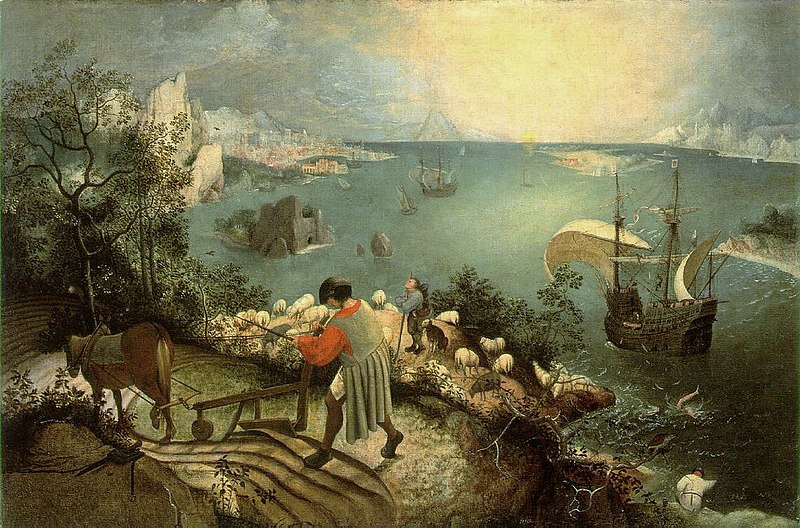
According to Brueghel
when Icarus fell
it was spring
a farmer was ploughing
his field
the whole pageantry
of the year was
awake tingling
near
the edge of the sea
concerned
with itself
sweating in the sun
that melted
the wings' wax
unsignificantly
off the coast
there was
a splash quite unnoticed
this was
Icarus drowning
by William Carlos Williams
Poet 4: Carl Sandburg
Carl Sandburg was born in Galeburg, Illinois in 1878. He was the son of Swedish immigrants, and I am the granddaughter of Swedish immigrant who immigrated to Illinois too. He was a Hobo at 19 years of age. He was in the Spanish-American War at the age of 20. He was a social democrat and was concerned for the plight of the American worker, and many of his poems reflect that.
His poems were powerful and accessible and packed a punch, especially "Planked Whitefish" (Gives you an idea of what he thought of war). I loved "Working Girls" because I imagined my Swedish immigrant grandmother going to work in Chicago in the 1920's. Here is a picture of them in Chicago when they were first married (1926)

WORKING GIRLS
THE working girls in the morning are going to work--
long lines of them afoot amid the downtown stores
and factories, thousands with little brick-shaped
lunches wrapped in newspapers under their arms.
Each morning as I move through this river of young-
woman life I feel a wonder about where it is all
going, so many with a peach bloom of young years
on them and laughter of red lips and memories in
their eyes of dances the night before and plays and
walks.
Green and gray streams run side by side in a river and
so here are always the others, those who have been
over the way, the women who know each one the
end of life's gamble for her, the meaning and the
clew, the how and the why of the dances and the
arms that passed around their waists and the fingers
that played in their hair.
Faces go by written over: "I know it all, I know where
the bloom and the laughter go and I have memories,"
and the feet of these move slower and they
have wisdom where the others have beauty.
So the green and the gray move in the early morning
on the downtown streets.
Wednesday, August 19, 2009
Robert Frost Reading at the Kennedy Inauguration
Robert Frost reading it is beautiful
This was totally moving. A reflection of Frost reading at Kennedy's inauguration. It made me cry!
Here is a very interesting piece of information about that original poem:
Visit msnbc.com for Breaking News, World News, and News about the Economy
Here is are the two poems:
Written in commemoration of John F. Kennedy's 1961 Inauguration
Dedication - The Complete Text
Summoning artists to participate
In the august occasions of the state
Seems something artists ought to celebrate.
Today is for my cause a day of days.
And his be poetry's old-fashioned praise
Who was the first to think of such a thing.
This verse that in acknowledgement I bring
Goes back to the beginning of the end
Of what had been for centuries the trend;
A turning point in modern history.
Colonial had been the thing to be
As long as the great issue was to see
What country'd be the one to dominate
By character, by tongue, by native trait,
The new world Christopher Columbus found.
The French, the Spanish, and the Dutch were downed
And counted out. Heroic deeds were done.
Elizabeth the First and England won.
Now came on a new order of the ages
That in the Latin of our founding sages
(Is it not written on the dollar bill
We carry in our purse and pocket still?)
God nodded his approval of as good.
So much those heroes knew and understood,
I mean the great four, Washington,
John Adams, Jefferson, and Madison
So much they saw as consecrated seers
They must have seen ahead what not appears,
They would bring empires down about our ears
And by the example of our Declaration
Make everybody want to be a nation.
And this is no aristocratic joke
At the expense of negligible folk.
We see how seriously the races swarm
In their attempts at sovereignty and form.
They are our wards we think to some extent
For the time being and with their consent,
To teach them how Democracy is meant.
"New order of the ages" did they say?
If it looks none too orderly today,
'Tis a confusion it was ours to start
So in it have to take courageous part.
No one of honest feeling would approve
A ruler who pretended not to love
A turbulence he had the better of.
Everyone knows the glory of the twain
Who gave America the aeroplane
To ride the whirlwind and the hurricane.
Some poor fool has been saying in his heart
Glory is out of date in life and art.
Our venture in revolution and outlawry
Has justified itself in freedom's story
Right down to now in glory upon glory.
Come fresh from an election like the last,
The greatest vote a people ever cast,
So close yet sure to be abided by,
It is no miracle our mood is high.
Courage is in the air in bracing whiffs
Better than all the stalemate an's and ifs.
There was the book of profile tales declaring
For the emboldened politicians daring
To break with followers when in the wrong,
A healthy independence of the throng,
A democratic form of right devine
To rule first answerable to high design.
There is a call to life a little sterner,
And braver for the earner, learner, yearner.
Less criticism of the field and court
And more preoccupation with the sport.
It makes the prophet in us all presage
The glory of a next Augustan age
Of a power leading from its strength and pride,
Of young amibition eager to be tried,
Firm in our free beliefs without dismay,
In any game the nations want to play.
A golden age of poetry and power
Of which this noonday's the beginning hour.
-Courtesy of the St. Lawrence University Archives
The Gift Outright
Poem recited instead by Robert Frost at the
1961 Inauguration
The land ws our before we were the land's.
She was our land more than a hundred years
Before we were her people. She was ours
In Massachusetts, in Virginia,
But we were England's, Still colonials,
Possessing what we still were unpossessed by,
Possessed by what we now no more possessed.
Something we were withholding from our land of living,
And forthwith found salvation in surrender.
Such as we were we gave ourselves outright
(The deed of gift was many deeds of war)
To the land vaguely; realizing westward,
But still unstoried, artless, unenhanced,
Such as she was, such as she would become.
The entire inaugural:
Poet 3: Robert Frost Continued
It has been a few days. So, I will continue.
Here is a little clip of him that is so interesting:
I still think that probably Robert Frosts most famous poem is my favorite. I found a recording of him reading it here:
This is something so historic about hearing his voice reading a poem he wrote. I find the cadence that he had intended. Here is the text of the poem:
Two roads diverged in a yellow wood,
And sorry I could not travel both
And be one traveler, long I stood
And looked down one as far as I could
To where it bent in the undergrowth;
Then took the other, as just as fair,
And having perhaps the better claim,
Because it was grassy and wanted wear;
Though as for that, the passing there
Had worn them really about the same,
And both that morning equally lay
In leaves no step had trodden black.
Oh, I kept the first for another day!
Yet knowing how way leads on to way,
I doubted if I should ever come back.
I shall be telling this with a sigh
Somewhere ages and ages hence:
Two roads diverged in a wood, and I---
I took the one less traveled by,
And that has made all the difference.
This is a poem so potent with meaning. What if he had taken the other road?
I couldn't find Robert Frost reading his poem at the JFK Inauguration, but Kennedy reads one of his poems about two minutes in. It is interesting:
Here is a little clip of him that is so interesting:
Slow on the Poets
I had ever intention of fnishing Frost yesterday. I did read quite a bit, but I didn't finish. I sort of had a meltdown. I was carrying some "backburner burdens" and didn't realize it until I snapped at a dear friend. I felt so bad, but she was forgiving, and I was able to cry over some hard things that are happening around me.
I am called to support a friend through a major crisis in her family. I skipped dinner with my family to be with her and just listen. It was important to do.
I wanted to crawl in a hold after snapping though. I don't like it when I do that.
Today is a better day. Jury Duty didn't happen. So, the slate is clean today.
Subscribe to:
Posts (Atom)
The Nightingale
From Wikipedia: The Nightingale (2015) is a historical fiction novel by American author Kristin Hannah published by St. Martin's Pres...

-
I had written my FACED (Food, Academic/Attitude, Communion, Exercise, Daily Care of Self and Family) group asking them to pray for me becaus...
-
Today is the 10 year anniversary of our liberation from a 28 year dysfunctional relationship (28 for me and less for my husband). I celeb...
-
This is really more a short essay, but it is profound and important. It is one of the best things I have ever read and a pplying it will cha...
