I did like "Shirt" because it told a story of worker abuse by talking about the shirt that he wears.
Here is a bit of commentary on it: http://www.english.illinois.edu/maps/poets/m_r/pinsky/shirt.htm
Here is the poem "The Shirt."
This these lines from Book III of "Asphodel, that Greeny Flower" is so profound:
"It is ridiculous
what airs we put on
to seem profound
while our hearts
gasp-dying
for want of love.
Having your love
I was rich.
Thinking to have lost it
I am tortured
and cannot rest.
I do not come to you
abjectly
with confessions of my faults,
I have confessed,
all of them.
In the name of love
I come proudly
as to an equal
to be forgiven.
Let me, for I know
you take it hard,
with good reason,
give the steps
if it may be
by which you shall mount,
again to think well
of me."
(NOTE: It is more powerful with his intended format. So you can see it in Google Books HERE)
I found this background to this particular part of the poem at http://www.writing.upenn.edu/~afilreis/88/asphodel.html:
"First published in Journey to Love (1955), "Asphodel, That Greeny Flower" came into existence during a time of nearly overwhelming crisis in Williams' life. Originally he thought of it as the fifth book of Paterson, gave it the working title "The River of Heaven," and planned for it to include "Everything left over that wasn't done or said--at ease." He began the poem in March 1952, on a hotel menu in New York City, and worked on it for nearly two years. During those years his health, which had begun to break with his heart attack in 1948 and strokes in 1949 and 1951, continued to deteriorate. He suffered another major stroke in August 1952, and knew that he could expect further strokes--any one of them possibly fatal--at any time from then on. His mental condition was likewise precarious. A bout with depression was exacerbated both by the recent stroke and by the injustices surrounding Williams' appointment as Poetry Consultant to the Library of Congress. The position was first offered, then withdrawn owing to allegations of Communist sympathizing, then offered again contingent upon further loyalty investigations, which were conducted but never evaluated, so that the year's term was up before Williams was able to serve. The situation tormented him with feelings of rage, powerlessness, and humiliation. On 21 February 1953, he was admitted to a private mental hospital in Queens, where he underwent psychiatric treatment until his release on 18 April.
Most painful of all, the old uneasy balance between confession and deceit in Williams' marriage to Flossie finally gave way. During his stay in the mental hospital, threatened by death and ready at last to let Flossie truly know him, he worked on poems, including "Asphodel," and wrote letters confessing past adulteries that finally compelled Flossie's full belief. The process must have been immeasurably painful for them both. Needing his wife to hold firm now more than ever, the poet must test her by buffeting and shaking her. "Having your love / I was rich," he tells her in "Asphodel." "Thinking to have lost it / I am tortured / and cannot rest." And so, in three "Books" and a "Coda," he writes to Flossie about the flower of the Elysian fields, the flower that grows also "in hell." The flower has a central meaning: "Of love, abiding love / it will be telling." In the first two Books he speaks of their marriage, their past, shared projects, triumphs, and griefs; in Book III he begs for forgiveness, but also writes movingly of desire, giving "the steps / if it may be / by which you shall mount, / again to think well / of me."
That is so deep!
Happiness
There's just no accounting for happiness,
or the way it turns up like a prodigal
who comes back to the dust at your feet
having squandered a fortune far away.
And how can you not forgive?
You make a feast in honor of what
was lost, and take from its place the finest
garment, which you saved for an occasion
you could not imagine, and you weep night and day
to know that you were not abandoned,
that happiness saved its most extreme form
for you alone.
No, happiness is the uncle you never
knew about, who flies a single-engine plane
onto the grassy landing strip, hitchhikes
into town, and inquires at every door
until he finds you asleep midafternoon
as you so often are during the unmerciful
hours of your despair.
It comes to the monk in his cell.
It comes to the woman sweeping the street
with a birch broom, to the child
whose mother has passed out from drink.
It comes to the lover, to the dog chewing
a sock, to the pusher, to the basket maker,
and to the clerk stacking cans of carrots
in the night.
It even comes to the boulder
in the perpetual shade of pine barrens,
to rain falling on the open sea,
to the wineglass, weary of holding wine.
-Jane Kenyon (from: http://thue.stanford.edu/jacquie/happ.html)
I especially liked her series of poetry regarding "Thomas and Beulah." According to Wikipedia.com, "Thomas and Beulah is a book of poems by American poet Rita Dove that tells the semi-fictionalized chronological story of her maternal grandparents, the focus being on her grandfather (Thomas, his name in the book as well as in real life) in the first half and her grandmother (named Beulah in the book, although her real name was Georgianna) in the second. It won the 1987 Pulitzer Prize for poetry."
It is too long to quote here, but it is here: http://en.wikipedia.org/wiki/Thomas_and_Beulah
| "We tend to be so bombarded with information, and we move so quickly, that there's a tendency to treat everything on the surface level and process things quickly. This is antithetical to the kind of openness and perception you have to have to be receptive to poetry. ... poetry seems to exist in a parallel universe outside daily life in America." |
| Rita Dove (b. 1952), U.S. poet. As quoted in the New York Times, sect. 4, p. 7 (June 20, 1993). |
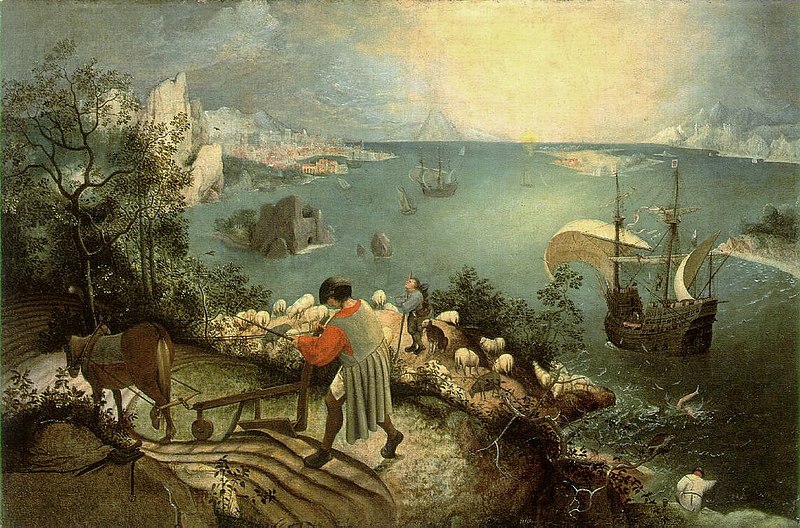
According to Brueghel
when Icarus fell
it was spring
a farmer was ploughing
his field
the whole pageantry
of the year was
awake tingling
near
the edge of the sea
concerned
with itself
sweating in the sun
that melted
the wings' wax
unsignificantly
off the coast
there was
a splash quite unnoticed
this was
Icarus drowning
by William Carlos Williams

THE working girls in the morning are going to work--
long lines of them afoot amid the downtown stores
and factories, thousands with little brick-shaped
lunches wrapped in newspapers under their arms.
Each morning as I move through this river of young-
woman life I feel a wonder about where it is all
going, so many with a peach bloom of young years
on them and laughter of red lips and memories in
their eyes of dances the night before and plays and
walks.
Green and gray streams run side by side in a river and
so here are always the others, those who have been
over the way, the women who know each one the
end of life's gamble for her, the meaning and the
clew, the how and the why of the dances and the
arms that passed around their waists and the fingers
that played in their hair.
Faces go by written over: "I know it all, I know where
the bloom and the laughter go and I have memories,"
and the feet of these move slower and they
have wisdom where the others have beauty.
So the green and the gray move in the early morning
on the downtown streets.
"Sail away from the safe harbor.Catch the trade winds in your sails.Explore. Dream. Discover." Mark Twain |
Visit msnbc.com for Breaking News, World News, and News about the Economy
Here is are the two poems:
Written in commemoration of John F. Kennedy's 1961 Inauguration
Dedication - The Complete Text
Summoning artists to participate
In the august occasions of the state
Seems something artists ought to celebrate.
Today is for my cause a day of days.
And his be poetry's old-fashioned praise
Who was the first to think of such a thing.
This verse that in acknowledgement I bring
Goes back to the beginning of the end
Of what had been for centuries the trend;
A turning point in modern history.
Colonial had been the thing to be
As long as the great issue was to see
What country'd be the one to dominate
By character, by tongue, by native trait,
The new world Christopher Columbus found.
The French, the Spanish, and the Dutch were downed
And counted out. Heroic deeds were done.
Elizabeth the First and England won.
Now came on a new order of the ages
That in the Latin of our founding sages
(Is it not written on the dollar bill
We carry in our purse and pocket still?)
God nodded his approval of as good.
So much those heroes knew and understood,
I mean the great four, Washington,
John Adams, Jefferson, and Madison
So much they saw as consecrated seers
They must have seen ahead what not appears,
They would bring empires down about our ears
And by the example of our Declaration
Make everybody want to be a nation.
And this is no aristocratic joke
At the expense of negligible folk.
We see how seriously the races swarm
In their attempts at sovereignty and form.
They are our wards we think to some extent
For the time being and with their consent,
To teach them how Democracy is meant.
"New order of the ages" did they say?
If it looks none too orderly today,
'Tis a confusion it was ours to start
So in it have to take courageous part.
No one of honest feeling would approve
A ruler who pretended not to love
A turbulence he had the better of.
Everyone knows the glory of the twain
Who gave America the aeroplane
To ride the whirlwind and the hurricane.
Some poor fool has been saying in his heart
Glory is out of date in life and art.
Our venture in revolution and outlawry
Has justified itself in freedom's story
Right down to now in glory upon glory.
Come fresh from an election like the last,
The greatest vote a people ever cast,
So close yet sure to be abided by,
It is no miracle our mood is high.
Courage is in the air in bracing whiffs
Better than all the stalemate an's and ifs.
There was the book of profile tales declaring
For the emboldened politicians daring
To break with followers when in the wrong,
A healthy independence of the throng,
A democratic form of right devine
To rule first answerable to high design.
There is a call to life a little sterner,
And braver for the earner, learner, yearner.
Less criticism of the field and court
And more preoccupation with the sport.
It makes the prophet in us all presage
The glory of a next Augustan age
Of a power leading from its strength and pride,
Of young amibition eager to be tried,
Firm in our free beliefs without dismay,
In any game the nations want to play.
A golden age of poetry and power
Of which this noonday's the beginning hour.
-Courtesy of the St. Lawrence University Archives
The Gift Outright
Poem recited instead by Robert Frost at the
1961 Inauguration
The land ws our before we were the land's.
She was our land more than a hundred years
Before we were her people. She was ours
In Massachusetts, in Virginia,
But we were England's, Still colonials,
Possessing what we still were unpossessed by,
Possessed by what we now no more possessed.
Something we were withholding from our land of living,
And forthwith found salvation in surrender.
Such as we were we gave ourselves outright
(The deed of gift was many deeds of war)
To the land vaguely; realizing westward,
But still unstoried, artless, unenhanced,
Such as she was, such as she would become.
The entire inaugural:
| Air a-gittin' cool an' coolah, Frost a-comin' in de night, Hicka' nuts an' wa'nuts fallin', Possum keepin' out o' sight. Tu'key struttin' in de ba'nya'd, Nary a step so proud ez his; Keep on struttin', Mistah Tu'key, Yo' do' know whut time it is. Cidah press commence a-squeakin' Eatin' apples sto'ed away, Chillun swa'min' 'roun' lak ho'nets, Huntin' aigs ermung de hay. Mistah Tu'key keep on gobblin' At de geese a-flyin' souf, Oomph! dat bird do' know whut's comin'; Ef he did he'd shet his mouf. Pumpkin gittin' good an' yallah Mek me open up my eyes; Seems lak it's a-lookin' at me Jes' a-la'in' dah sayin' "Pies." Tu'key gobbler gwine 'roun' blowin', Gwine 'roun' gibbin' sass an' slack; Keep on talkin', Mistah Tu'key, You ain't seed no almanac. Fa'mer walkin' th'oo de ba'nya'd Seein' how things is comin' on, Sees ef all de fowls is fatt'nin' -- Good times comin' sho's you bo'n. Hyeahs dat tu'key gobbler braggin', Den his face break in a smile -- Nebbah min', you sassy rascal, He's gwine nab you atter while. Choppin' suet in de kitchen, Stonin' raisins in de hall, Beef a-cookin' fu' de mince meat, Spices groun' -- I smell 'em all. Look hyeah, Tu'key, stop dat gobblin', You ain' luned de sense ob feah, You ol' fool, yo' naik's in dangah, Do' you know Thanksgibbin's hyeah? (from www.PoemHunter.com) |

She told the story, and the whole world wept
At wrongs and cruelties it had not known
But for this fearless woman's voice alone.
She spoke to consciences that long had slept:
Her message, Freedom's clear reveille, swept
From heedless hovel to complacent throne.
Command and prophecy were in the tone,
And from its sheath the sword of justice leapt.
Around two peoples swelled a fiery wave,
But both came forth transfigured from the flame.
Blest be the hand that dared be strong to save,
And blest be she who in our weakness came—
Prophet and priestess! At one stroke she gave
A race to freedom, and herself to fame.
Paul Laurence Dunbar
| Printed from Uncle Tom's Cabin & American Culture © 2006 the University of Virginia http://utc.iath.virginia.edu/ Stephen Railton; Institute for Advanced Technology in the Humanities; Electronic Text Center Charlottesville, Virginia 1999 |
 It is excellent! (watch online here: Walt Whitman Program
| AN old man bending I come among new faces, | |
| Years looking backward resuming in answer to children, | |
| Come tell us old man, as from young men and maidens that love me, | |
| (Arous’d and angry, I’d thought to beat the alarum, and urge relentless war, | |
| But soon my fingers fail’d me, my face droop’d and I resign’d myself, | 5 |
| To sit by the wounded and soothe them, or silently watch the dead;) | |
| Years hence of these scenes, of these furious passions, these chances, | |
| Of unsurpass’d heroes (was one side so brave? the other was equally brave;) | |
| Now be witness again, paint the mightiest armies of earth, | |
| Of those armies so rapid so wondrous what saw you to tell us? | 10 |
| What stays with you latest and deepest? of curious panics, | |
| Of hard-fought engagements or sieges tremendous what deepest remains? | |
2
O maidens and young men I love and that love me, | |
| What you ask of my days those the strangest and sudden your talking recalls, | |
| Soldier alert I arrive after a long march cover’d with sweat and dust, | 15 |
| In the nick of time I come, plunge in the fight, loudly shout in the rush of successful charge, | |
| Enter the captur’d works—yet lo, like a swift-running river they fade, | |
| Pass and are gone they fade—I dwell not on soldiers’ perils or soldiers’ joys | |
| (Both I remember well—many the hardships, few the joys, yet I was content). | |
| But in silence, in dreams’ projections, | 20 |
| While the world of gain and appearance and mirth goes on, | |
| So soon what is over forgotten, and waves wash the imprints off the sand, | |
| With hinged knees returning I enter the doors (while for you up there, | |
| Whoever you are, follow without noise and be of strong heart). | |
| Bearing the bandages, water and sponge, | 25 |
| Straight and swift to my wounded I go, | |
| Where they lie on the ground after the battle brought in, | |
| Where their priceless blood reddens the grass, the ground, | |
| Or to the rows of the hospital tent, or under the roof’d hospital, | |
| To the long rows of cots up and down each side I return, | 30 |
| To each and all one after another I draw near, not one do I miss, | |
| An attendant follows holding a tray, he carries a refuse pail, | |
| Soon to be fill’d with clotted rags and blood, emptied, and fill’d again. | |
| I onward go, I stop, | |
| With hinged knees and steady hand to dress wounds, | 35 |
| I am firm with each, the pangs are sharp yet unavoidable, | |
| One turns to me his appealing eyes—poor boy! I never knew you, | |
| Yet I think I could not refuse this moment to die for you, if that would save you. | |
3
On, on I go, (open doors of time! open hospital doors!) | |
| The crush’d head I dress (poor crazed hand tear not the bandage away), | 40 |
| The neck of the cavalry-man with the bullet through and through I examine, | |
| Hard the breathing rattles, quite glazed already the eye, yet life struggles hard | |
| (Come sweet death! be persuaded O beautiful death! | |
| In mercy come quickly). | |
| From the stump of the arm, the amputated hand, | 45 |
| I undo the clotted lint, remove the slough, wash off the matter and blood, | |
| Back on his pillow the soldier bends with curv’d neck and side-falling head, | |
| His eyes are closed, his face is pale, he dares not look on the bloody stump, | |
| And has not yet look’d on it. | |
| I dress a wound in the side, deep, deep, | 50 |
| But a day or two more, for see the frame all wasted and sinking, | |
| And the yellow-blue countenance see. | |
| I dress the perforated shoulder, the foot with the bullet-wound, | |
| Cleanse the one with a gnawing and putrid gangrene, so sickening, so offensive, | |
| While the attendant stands behind aside me holding the tray and pail. | 55 |
| I am faithful, I do not give out, | |
| The fractur’d thigh, the knee, the wound in the abdomen, | |
| These and more I dress with impassive hand (yet deep in my breast a fire, a burning flame). | |
4
Thus in silence in dreams’ projections, | |
| Returning, resuming, I thread my way through the hospitals, | 60 |
| The hurt and wounded I pacify with soothing hand, | |
| I sit by the restless all the dark night, some are so young, | |
| Some suffer so much, I recall the experience sweet and sad, | |
| (Many a soldier’s loving arms about this neck have cross’d and rested, | |
| Many a soldier’s kiss dwells on these bearded lips). | 65 |
I was going to use a prompt from Julie's Bravewriter website, but I decided to just write on whatever without a prompt. It has been a w...


