Wednesday, February 23, 2022

Freewrite before the RUN TO THE NUNS

I am so happy to have just this 15 minutes for a freewrite. Something I have not done for quite a while because I have been doing "Morning Pages" ala The Artist's Way. I am not going to lie, the discipline of writing three handwritten notebook size pages every morning has been SO GOOD! (I know you probably thought I was going to say that I was not going to lie about it being super tough, but NO! I love it. Kinda' like I'm not going to lie, prayer is a joy and delight for me. Suffice it to say that I won't be speaking at any women's retreats because I don't struggle like most people do in things most people do struggle. I acknowledge that the struggle IS REAL FOR MOST PEOPLE, and I have great compassion for everyone. But I digress - But this is MY freewrite, and I can digress all I want. Tee Hee.

So here I am writing away until I join the nuns of East Mosely (near London - I think) for their 8:30 pm Centering Prayer period. I was not able to join that for Monday and Tuesday because the last two days have been somewhat hectic. But I don't mind. I don't feel guilty if I miss a prayer period. 

I led a 2nd Half Collaborative small group this morning for 90 minutes. Those times just take so much out of me. I have to be so honest about that (That is where I can say, "Not going to lie - it is tough for me to lead small groups. You would think after 40+ years of leading small groups - my first one being 1979 - It would be easy. I am capable, but it is not easy for me. Spiritual direction one-on-one - a synch though.) I am tired from the time. I love all those people. I think I just long for a longer conversation than just a snippet of 10-15 minutes, and I don't like rushing people through the time, but I have to because there are 6 people who need to share in 90 minutes. So, it is sort of stressful for me. I am much less stressful about the other group I lead: The Order of the Mustard Year of Preparation Cohort. I have four people to share in 2 hours. That is so much more manageable, even though I have quite a bit more content to get through with the Order of the Mustard Seed people. 

I think I am medium nervousness about the group that I lead on Friday mornings. I have different groups of people doing it. I am taking a break though until after June! 

I gotta run to the nuns for Centering Prayer!

Sunday, February 06, 2022

Zen in the Art of Archery


I am really glad I read this! I have never really understood what "Zen" is, and this helped sum it up. A German philosopher, Eugen Herrigel, went to Japan and learned archery from a Japanese master and wrote about it. 

Eastern philosophy is so different from Western! We could learn a ton from them, and I can do it without compromising any of my faith! So here are so quotes that were perfectly timed as I was contemplating a certain method that looks at strategy and statistics which I cannot help but think leads to ego gratification. It is when we are indifferent (Ignatian concept here) to success that we can proceed. 

I also could not help but think about the movie, Karate Kid, the whole time I was reading this! 

Great Quotes:


"The right art ", cried the Master, `is purposeless, aimless! The more obstinately you try to learn how to shoot the arrow for the sake of hitting the goal, the less you will succeed in the one and the further the other will recede. What stands in your way is that you have a much too wilful will. You think that what you do not do yourself does not happen. " p. 31

Assuming that his talent can survive the increasing strain, there is one scarcely avoidable danger that lies ahead of the pupil on his road to mastery. Not the danger of wasting himself in idle self−gratification ˙ for the East has no aptitude for this cult of the ego but rather the danger of getting stuck in his achievement, which is confirmed by his success and magnified by his renown: in other words, of behaving as if the artistic existence were a form of life that bore witness to its own validity.

The teacher foresees this danger. Carefully and with the adroitness of a psychopomp he seeks to head the pupil off in time and to detach him from himself. This he does by pointing out, casually and as though it were scarcely worth a mention in view of all that the pupil has already learned, that all right doing is accomplished only in a state of true selflessness, in which the doer cannot be present any longer as " himself ". Only the spirit is present, a kind of awareness which shows no trace of ego− hood and for that reason ranges without limit through all the distances and depths, with " eyes that hear and with ears that see ". p.43-44

How does skill become " spiritual ", and how does sovereign control of technique turn into master swordplay? Only, so we are informed, by the pupil becoming purposeless and egoless. He must be taught to be detached not only from his opponent but from himself. He must pass through the stage he is still at and leave it behind him for good, even at the risk of irretrievable failure. Does not this sound as nonsensical as the demand that the archer should hit without taking aim, that he should completely lose sight of the goal and his intention to hit it? p. 73


Here is why James Mustich thinks it should be one of the 1000 Books to Read Before You Die:
When Eugen Herrigel, a German professor of philosophy, went to Tokyo in the 1940s, he studied ikebana (the Japanese art of flower arranging), apprenticed to a master of archery, and spent six years studying Zen Buddhism through those activities. Zen in the Art of Archery is his distillation of that experience, an attempt to make the purpose of Zen practice understandable to those outside of its native culture. Despite the wide dissemination of Zen ideas in the ensuing years, Herrigel’s book remains an illuminating, graceful, and inspiriting introduction, through Western eyes, to the meditative insight of Eastern philosophy.

Saturday, February 05, 2022

In Our Time by Ernest Hemingway


Hemingway is not my favorite author. I thought I was DONE reading all the recommended classics on all the lists, but here was yet ONE MORE!

This is a bunch of short stories. Hemingway conveys emotion in very few words. I can see why he was famous, but his deep sadness comes across in all his writing. So, I don't like to read him (except The Old Man and the Sea). This motivated me to watch the Ken Burns PBS documentary on Hemingway. 

Here is why James Mustich thinks it should be one of the 1000 Books to Read Before You Die:
Following upon the appearance of two small volumes in Paris, In Our Time was Hemingway’s first full-length book, and his first published in the United States. It is composed of sixteen stories, each followed by a brief prose interlude—often a paragraph, never longer than a single page—labeled as a numbered “chapter.” The chapters—scenes of peril and desperation drawn from the battlefield, the bull ring, and the annals of American urban violence—act as a kind of visceral punctuation to the stories, giving an ominous historical context. The disciplined directness of Hemingway’s expression—the way each word seems chosen and set with care, the modulation of cadence, the telling use of quiet—informs a style of stunning alertness as he explores youth’s conversion from innocence to experience. Although the character of Nick Adams is not central to every tale, the course of his coming-of-age shapes the book’s development. We share his youth and his admiration for his doctor father, the confusions of his first romance, his friendships, the aftermath of his wartime ordeal, and his fragile determination to make a home for himself in a homeless world. All the while, the something out there that’s not fooling infiltrates the space between the lines to intensify the hues of Hemingway’s attention to life, love, and death. Despite—or perhaps because of—its often miniaturist scale, In Our Time may well be the truest expression of its author’s prodigious gifts.

My Family and Other Animals


This is a dramatic BBC Version of this book. It is very entertaining. What a dysfunctional family that totally loves one another. It is the story behind the TV series Durrells in Corfu. 

Here is the author's biography from Goodreads:


Gerald "Gerry" Malcolm Durrell was born in India in 1925. His elder siblings are Lawrence Durrell, Leslie Durrell, and Margaret Durrell. His family settled on Corfu when Durrell was a boy and he spent his time studying its wildlife. He relates these experiences in the trilogy beginning with My Family and Other Animals, and continuing with Birds, Beasts and Relatives and The Garden of the Gods. In his books he writes with wry humour and great perception about both the humans and the animals he meets.

On leaving Corfu he returned to England to work on the staff of Whipsnade Park as a student keeper. His adventures there are told with characteristic energy in Beasts in My Belfry. A few years later, Durrell began organising his own animal-collecting expeditions. The first, to the Cameroons, was followed by expeditions to Paraguay, Argentina and Sierra Leone. He recounts these experiences in a number of books, including The Drunken Forest. Durrell also visited many countries while shooting various television series, including An Amateur Naturalist. In 1958 Gerald Durrell realised a lifelong dream when he set up the Jersey Zoological Park, followed a few years later by the Jersey Wildlife Preservation Trust.

Durell was married twice; Jacquie Durrell (1951-1979), Lee Durrell (1979-1995).

Gerald Durrell's style is exuberant, passionate and acutely observed. Gerald Durrell died in 1995.

There are several books on the 1000 Books to Read Before You Die List written by his brother, Lawrence.

Here is why James Mustich thinks it should be one of the 1000 Books to Read Before You Die:

It’s a cliché that an unhappy childhood gives a writer ideal material. In the case of Gerald Durrell, however, just the opposite occurred: A blissfully happy childhood not only supplied him with wonderful matter for several bestselling books, but also started him on his life’s path to a career as a famous naturalist, zoologist, and conservationist. Warmly humorous, replete with intriguing natural history, and delighting in the merry eccentricities of the Durrell household, My Family and Other Animals is a splendid trip in very good company.

Autobiography of a Face


Wow! This is quite a book. I am really glad I read it. She is able to communicate her journey so beautifully. 

Here is why James Mustich thinks it should be one of the 1000 Books You Read Before You Die:

Lucy Grealy was nine years old when it was discovered she had cancer. Years of grueling treatment followed, including nearly thirty operations and the partial removal of her jaw. Autobiography of a Face is Grealy’s powerful, riveting account of growing up during those two decades in a society whose true religion often seems to be the worship of physical perfection.

Sunday, January 30, 2022

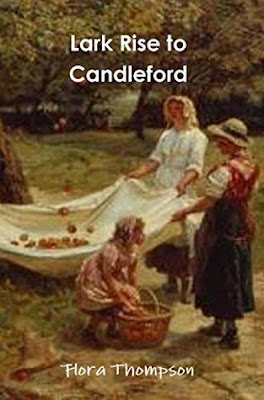
Lark Rise to Candleford


If you are looking for the same thing you saw in the TV series, this is not going to satisfy you. Dorcas Lane, who is one of the main characters in the TV series, does not even make an appearance until 2/3rds of the way through the book. The story of Laura moving over to Candleford (Candleford Green in the book) happens even later. 

All that said, the first book (this book is a trilogy: Lark Rise, Over to Candleford, and Candleford Green) is a detailed description of Laura's hamlet of Lark Rise. It is not a story with a plot. Really, there is only a little bit of story even in the third book. I found the first part a bit of a slog to get through because it was a little too detailed for my taste. I liked the last book the best because there was a bit of a story, and it had many of the characters that are in the series. 

It was a good read though. I have wanted to read it for years. One of my acquaintances even gave me this book to read for an indefinite period of time, but I finally gave it back to her thinking I would never get around to reading it. Then it appeared on James Mustich's 1000 Books to Read Before You Die list. So it was required reading! (LOL!)

I loved the last paragraph that sums up the book pretty beautifully:

"As she went on her way, gossamer threads, spun from bush to bush, barricaded her pathway, and as she broke through one after another of these fairy barricades she thought, 'They're trying to bind and keep me.' But the threads which were to bind her to her native county were more enduring than gossamer. They were spun of love and kinship and cherished memories." 

Here is why James Mustich thinks it should be one of the 1000 Books You Read Before You Die:

Detailing life in a country village in the years before the Industrial Revolution, Lark Rise to Candleford is a fictionalized autobiography. Its charming remembrance of local customs, crafts, and culture is distinguished by its fidelity to the roaming curiosity of a child’s eye, as an early passage illustrates: "One old woman once handed the little girl a leaf from a pot-plant on her window-sill. 'What’s it called?' was the inevitable question. 'Tis called mind your own business,' was the reply; 'an’ I think I’d better give a slip of it to your mother to plant in a pot for you.”' What’s most pleasing about Thompson’s writing is the easy confidence of her affectionate portrayal of times past. Farmers and traveling vendors, family and schoolwork, seasonal festivals and the small matters of community life are recalled, and the natural beauty of the English countryside is quietly honored by exact description. This is not only a book that evokes a lost world, but one that transports us to a simpler era with clarity and calm attention.
The real towns were Juniper Hill (Lark Rise) and Cottisford (Candleford), but in the second to last episode, Laura (who is Flora Thompson), mentions all the towns she goes to in the area, and those are real towns. So, being the nerd that I am, made a map of all those towns in the area. We were so close to them when we were in England. It would have been fun to stop by!


The Afghanistan Papers: A Secret History of the War


I think this was an important book to read. I had gotten the hard copy to see all the color pictures included in the book. Then I got the audiobook for the written content. 

No surprise. It was a case of "mission creep" and thinking we could impose our American values of democracy on a country that has had tribes warring with each other for centuries. No one political party is to blame. No president current or past is to blame. 

We just made a mistake by going in to get Bin-Laden and staying there even after he was not there. 

It was a stupid war that cost BILLIONS in taxpayer money and many young people's lives. Sad. 

My only criticism is the author kept on referring to where he got his information from "oral interview" or "lessons learn interview" got so annoying to hear over and over and over again. Leave that out in your reprint and just mention it at the beginning or make it a footnote. It must have been said over 1000 times! Other than that, it was an excellent book. 


Friday, January 21, 2022

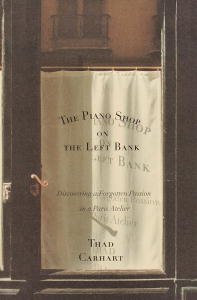
The Piano Shop on the Left Bank


This is such a dear little book. Piano in Paris. If you love good writing, music, and France, you will probably love this book. 


Here is why James Mustich thinks it should be one of the 1000 Books You Read Before You Die:

Every morning, as he walked his children to school through his Paris neighborhood, American transplant Thad Carhart passed a modest storefront that intrigued him. “Desforges Pianos: outillage, fournitures” announced its stenciled sign, and the tools and components of piano repair displayed in its window—tightening wrenches, tuning pins, pieces of felt, small pieces of hardware—illustrated the work that went on behind the glass. Venturing inside on several occasions to express his interest in acquiring a used piano, Carhart was mysteriously rebuffed. The shop seemed as determined in its reserve as the most punctilious Parisian aristocrat. Carhart’s cracking of the code of that reserve—he must, he learns, be recommended to the shop by one of its existing customers—is his first step into the “intricate world of mutual trust and obligation” that is the city’s hidden community, “the complicated network of local relationships that it was extremely difficult for a foreigner to penetrate.” Carhart effortlessly delivers an informative course in the history and construction of pianos and offers more insight into the French temperament than you might discover in a dozen weightier tomes. Best of all, he introduces us to an unforgettable cast of characters, including the tuner Jos, who sleeps in empty trains; Carhart’s Hungarian teacher, Anna, who reacquaints the author with the pleasures of Bach and Bartók, Schumann and Schubert; and, most memorably, Luc, the master of the atelier, whose expertise and gift for friendship is portrayed with great affection.

Tuesday, January 18, 2022

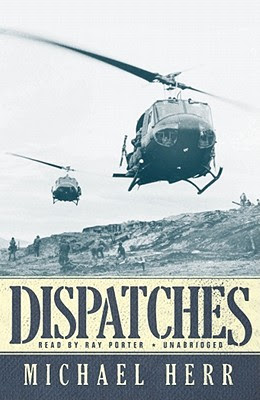
Dispatches


This is the first up-close account of the Vietnam War from a journalist's perspective. WOW! So good. Sobering. My father-in-law was a surgeon during the Tet Offensive. So during that part of the book, I was all ears!

A very worthy read. BUT it is tough. 

The author mentions Errol Flynn's only son in the book. He was a photojournalist in Vietnam. Here is an article on his disappearance:


Here is why James Mustich thinks it should be one of the 1000 Books You Read Before You Die:

Between 1967 and 1969, journalist Michael Herr was in Vietnam, reporting on the war for Esquire magazine. Dispatches is his episodic personal account of that experience. The conflict Herr covered has sometimes been referred to as America’s “first rock ‘n’ roll war,” and there’s certainly a head-banging, heavy-metal swagger to the author’s juiced-up prose. Through each stunning sequence, Herr remains alert to the trauma, terror, language, and longing of the soldiers he is watching kill and die. An electric pulse of desperation sears their humanity, and the author bears witness to the pain of the burns. 

A Month in the Country


What a lovely book. It is so beautifully written. He paints such a picture and a good story. The Colin Firth movies from 35 years ago was great to watch afterwards too! 

Here is why James Mustich thinks it should be one of the 1000 Books You Read Before You Die:

At the outset of A Month in the Country, Tom Birkin, a World War I survivor and a veteran of a broken marriage, arrives in a remote Yorkshire village to restore a medieval mural in the local church. Setting up his summer abode in the bell tower, he is charmed by the blooming countryside even as he passes his days absorbed in resurrecting an anonymous artist’s apocalyptic vision. It is, of course, Birkin’s own restoration to faith in life that Carr tellingly portrays, through a season of consolation and renewal that’s enduring despite its swift passage. Simple in outline and wonderfully well written, A Month in the Country is hauntingly beautiful in its effect.

Can't We Talk About Something More Pleasant


Wow! I loved this graphic memoir by a New Yorker illustrator. As someone heavily involved in end-of-life care for both my parents, I could relate to so much in this memoir. It is beautiful. Really a great read.

 
Here is why James Mustich thinks it should be one of the 1000 Books You Read Before You Die:

Since her work as a cartoonist began appearing in The Village Voice and The New Yorker in the late 1970s, Roz Chast’s distinctive combination of scraggly linework, schlumpy figures, and off-kilter frame of mind has made her a singular presence in American humor. Can’t We Talk About Something More Pleasant? is Chast’s first full-length book project, and it brings her peculiar gifts to bear on a theme particularly suited to them: the end days of her parents and her own shifting reactions to their senescence and mortality. Prompted by the unprecedented intimacy of the material, Chast imbues her graphic memoir with an astonishing honesty and emotional eloquence, extending her idiosyncratic perspective on everyday life to the most dumbfounding subject of all: everyday death.


Trojan Women by Euripedes


I have read The Illiad and The Odyssey so this was a pretty easy read for me. I think it might be a little harder for someone who has no background in these stories. 

Women are always collateral damage! Yuk! 

I agree with Mustich's quote below, "Euripides created a work that has endured as one of the most powerful expressions of the human costs of militarism and war, a play both artful and authentic in equal measure." 

Here is why James Mustich thinks it should be one of the 1000 Books You Read Before You Die:

The Trojan Women is more than a mere repetition of what, at the time of the play’s writing, was an already ancient tale of Troy’s burning and the slaughter of its men and subjugation of its women and children by a savage enemy. Only a few months before this tragedy was first staged, Athenian forces had imposed the same brutal terms of massacre and enslavement on the citizenry of Melos in retribution for that island city’s refusal to join the alliance against Athens’s rival, Sparta. By telescoping for his audience the foregone grief of the Trojan women with the fresh suffering of their counterparts on Melos, Euripides created a work that has endured as one of the most powerful expressions of the human costs of militarism and war, a play both artful and authentic in equal measure. 


Alcestis by Euripedes


I thought I had read all the Euripedes on the list, but I found two more! I thought this was a very accessible story, and the Librivox cast recording of it was lovely and FREE!


Here is why James Mustich thinks it should be one of the 1000 Books You Read Before You Die:

A king—Admetus—is offered a “Get Out of Death” card, but it doesn’t come free: He must find someone to take his place. Selflessly, his wife—Alcestis—volunteers to pay the price for him. Her expressions of love and farewell to Admetus and their children on her deathbed are filled with dignity and imposing grief, but what ensues after her passing, on the plot’s way to rescuing her from the underworld, turns from the tragic toward the comic (though many of the characters’ speeches seem suspended somewhere between the two).

Thursday, January 13, 2022

Freewrite Sixteen Minutes at Six Sixteen

From: https://www.facebook.com/psalmistdelfreda/

I have already written my "Morning Pages," but I do miss my freewrites here. So I am going to take sixteen minutes for one. 

Yesterday was a good day. These are the verses that I chewed on . . . 

I hear the Lord saying,
"I will stay close to you,
instructing and guiding you along the pathway of life.
I will advise you along the way 
and lead you forth with my eyes as your guide
So don't make it difficult; 
don't be stubborn
When I take you where you've not been before.
Don't make me tug you and pull you along
Just come with me!" Psalm 32:8-9

All last year, God took me on a new path. I think it is one I have always sort of avoided, but it worked out great, and I made friends along the way. I went in not thinking that I had to earn love, and that was a great perspective for me to go into and really into any relationship. 

He was close to me the whole time through the challenges of leadership. Now, I am being invited into dreaming sessions for a whole organization. I did not go in with shyness or apprehension or fear. I went in with boldness and heart. So that was a good thing. 

So leadership is not what I am seeking. So I think this year He will take me where I have not been before, and I want to go there. I don't want to have to be tugged or pulled along because he is WITH ME. That is so huge for me to fathom. I know that You, KING OF GLORY, are with me. So, I am not alone. I am lifting up my head to see the KING OF GLORY come with me. Eyes on Him alone, not on the people. I am mixing up yesterday's Psalm and today's because Jason and the gang (there were 9 of us this morning) meditated in Psalm 24 today. I think I go into things with my head down, there is shame, there is fear of rejection or assumed rejection where there is none. Come to think of it, I have really only experienced rejection one time in the last 10 years. I know that I have been excluded from things at my church, but I don't think I see that as rejection because I have not been around indicating that I wanted to be included. So, I wouldn't really see that as rejection. So, why do I assume it? I stepped back from a job yesterday, and my boss said, "Whenever you want to come back, we would love to have you." That was so sweet! I wasn't expecting that. I just assume they wouldn't want me back. 

On another note, I met with a potential directee and was pleasantly surprised that it would be a good fit! I did not think leading up to it that it would be. I really enjoyed our time together. We can give it a few times. Then we can reevaluate, but I would like to go down this road for a bit. 

She is similar to someone who interviewed me for direction about  1 1/2 years ago. She thought we would be a great fit, but I was pretty full up with others. I really liked her, but she prayed about it and thought we were too similar for it to work. I was so at peace because I didn't feel like it was right even though we clicked. This one just felt right. She is very teachable (funny that they both have the same name too).

Tuesday, January 11, 2022

Fifteen Minutes Freewrite at Five

I fell asleep watching this, but it is so good!


I woke up very early because I fell asleep very early. I have a meeting at 10 pm tonight so I must take a nap in the midmorning because I think a nap after I come home from class at 3:30 pm will be too late. Or maybe not. 

We were watching All Creatures Great and Small on Oregon Public Broadcasting where I realized that I could not keep my eyes open. I should have said that 10 pm would not work for me. I don't even know what this meeting is about, and I got this one-line question from the person who is calling the meeting, and when I asked for clarification, there was none. I don't know why she singled me out about it and asked me to talk about that without any detail. Then the group meeting was not scheduled during any of the times I was available. Is this how it is going to be, a 10 pm meeting? I want to have a good attitude going into the meeting. (Update: it was a great meeting, and I totally misunderstood the text and she was asking if I was coming because I realized I had forgotten to RSVP! All my deal, not hers. It will be a great partnership. Learning that it is OK to process my feelings and then go into meetings assuming the BEST of people: the "Ignatian Plus Sign"!

Today's Lectio365 was about being honest with God, and I don't think I have a problem with that. I had a sweet moment with God this morning in Luke 15 where I imagined my dad running toward me and embracing me. What I wouldn't give for that embrace with that big daddy of mine. I remember being honest with him and pouring out my heart to him and not having a problem with it. So, my goodness. Being honest with God is not one of my issues. I think my issue is more being honest with people in the sense that I am not necessarily lying to people, but sometimes I am afraid to tell them what I am thinking for fear of their reaction. Like saying, "A 10 pm meeting does not work for me in the long-term." It is funny because I was less that way in high school. I was much more direct and bold. Sometimes, it really is because I don't know what I want or what my opinion is until later. That is why I am a bit scared about this meeting today because I am not really sure what is expected of me in it, and I might have to think about it and get back to them. 

Oh well, I had discussed with George about meeting with C on a regular basis just to give me more time with an older woman. I sure miss Ginny and Lorraine. They were the best of older women. I have wanted to talk to Fran for a while, but she got COVID! Four of my students have COVID. It means so much more work for me! I am thinking about maybe this might be my last year there. I love teaching, but I don't like teaching at the time of COVID. I don't like having to wear a mask (my glasses fog up or fall off and have broken twice as a result). I don't like not seeing my students because I have to take my glasses off because they fog up and fall off so much while I am exercising. 

I do like students and coworkers though. I like getting on my bike and going to campus. It gets me out of the house. I like college students with their moldable minds and body. I love the conversations I have with them before and after class.

So I don't know. But it is 15 minutes so that was my rambling on a Tuesday morning. Speaking of students, I need to do my attendance from last Thursday! BYE! 

Sunday, January 09, 2022

The Chemical History of the Candle


I burn a candle most mornings, and I have never really thought about how a candle burns. The nerdy side of me sort of enjoyed this.  I listened to it with Librivox, and the narrator was excellent! 

From Amazon:

The greatest experimental scientist Michael Faraday delivered these six lectures at London's Royal Institution. Their subjects include the components, function, and weight of the atmosphere; capillary attraction; the carbon content in oxygen and living bodies; respiration and its analogy to the burning of a candle; and much more. Numerous illustrations.


Here is why James Mustich thinks it is one of the 1000 Books to Read Before You Die:

This captivating little book collects six demonstration lectures originally addressed to a group of young people at London’s Royal Institution in 1860 by the eminent British experimental scientist best known for his contributions to our understanding of electricity. Elucidating the chemical and physical properties and processes that conspire in a burning candle, Faraday delivers a splendid course in what was called, in his epoch, “natural philosophy.” One of the most treasured and widely disseminated works of popular science ever written, it has been fondly recalled as a formative inspiration by many scientists, including Oliver Sacks.

Since I started out this year with "Don't Let the Light Go Out" by Peter, Paul, and Mary, I love that the presenter, after explaining the "carbon footprint" of different animals and people through respiration, concluded his lectures with this:

In the lungs, as soon as the air enters, it unites with the carbon; even in the lowest temperature which the body can bear short of being frozen, the action begins at once, producing the carbonic acid of respiration: and so all things go on fitly and properly. Thus you see the analogy between respiration and combustion is rendered still more beautiful and striking. Indeed, all I can say to you at the end of these lectures (for we must come to an end at one time or other) is to express a wish that you may, in your generation, be fit to compare to a candle; that you may, like it, shine as lights to those about you; that, in all your actions, you may justify the beauty of the taper by making your deeds honourable and effectual in the discharge of your duty to your fellow-men.


Text for all the nerdy lectures found here:

https://ia803007.us.archive.org/22/items/diary182061/The%20Chemical%20History%20of%20a%20Candle.pdf  

The Flowers of Evil


 Baudelaire's poetry was considered scandalous at the time. He influenced Eliot though, whom I love. So I had to read him. They are beautifully written but gritty in some parts. 

The man led a sad life (he loved Edgard Allen Poe so that should tell you something) and died in his forties due to poor health brought on by addiction. Sad life, but he would write. 

Here is why James Mustich thinks it is one of the 1000 Books to Read Before You Die:
The Flowers of Evil (Les Fleurs du mal) was Baudelaire’s first volume of poems, and it announces its sumptuous depravity right from the start. On account of its descriptions of “unnatural” sex, its fiendish insistence on the connection between sexuality and death, and its vivid portraits of urban seediness, The Flowers of Evil led to Baudelaire’s prosecution for public indecency upon its original publication in 1857. Six poems were banned, and Baudelaire was fined three hundred francs. If the shudder came from the poet’s caress of corruption, drunkenness, and melancholy, the lasting thrill came from his unabashed conviction that the dignity of art and even beauty fell outside the borders of morality.

The Mezzanine


 I think most people would read this and think it is a pretty ridiculous book, but anyone who has read Proust, who went on and on about many of his childhood memories and the Madeleine, will "get" this and find the book hilariously funny! I did.

I am a bit younger than the author, but I liked him going on and on about the transition from glass delivery milk to the grocery store milk carton. I remember the waning days of delivery, even though I think my family was an early adopter of the milk carton. In my world, the people who still had milk delivery were the "rich" people. 

His footnotes got a bit laborious to read, but they really need to be read in order to fully appreciate the book.

Here is the reason why James Mustich says you need to read this before you die:

The plot of Nicholson Baker’s debut novel is simple: A man, returning to his office building from a lunch hour that included milk, a cookie, a small errand, and a stroll, goes up an escalator. That’s it. Only 135 pages long, and graced with numerous lengthy and absorbingly digressive footnotes, this is a wise, patient exploration of that unseen mental space in which we pass our time—and it’s very funny to boot.

The Power and the Glory by Graham Greene


This is my third Graham Greene, but the man can write! I found this book simple and beautiful. It is the story of the "Whisky Priest" and God's grace even though we have all "sinned and fall short of the glory of God" Rm 3:23).  God's glory is all over this book. I loved it. I had no idea that priests were outlawed in Mexico in the 30s! I still need to research this. 


James Mustich thinks you need to read this because...
Set in Mexico in the 1930s, when the Catholic Church has been outlawed by the revolutionary government, The Power and the Glory portrays a corrupted and courageous cleric’s devotion to his calling, despite his alcoholism (Greene gives him no name other than “the whisky priest”), his licentiousness (his fatherhood is emblem of his forsaken chastity), and his tortured alertness to his unworthiness. Knowing he risks execution by carrying the sacraments from village to village and nourishing as best he can the spiritual needs of the poor, he struggles to uphold the vision of a God who both eludes and exhilarates him. Damned if he does and damned if he doesn’t, the whisky priest is a hero who, in his very unfitness for the role, reveals the imaginative nobility of faith, hope, and love even in—especially in—the most unexalted settings.

Thursday, January 06, 2022

Freewrite Fifteen for 2022


Happy Kings' Day 

Well, I am already doing the "Morning Pages," but I miss my fingers going across the keys and just typing away on a Freewrite for Fifteen minutes. Sometimes I will just do both, and it looks like much of the hubbub of getting back to work has subsided. I think I will take a break from leading a prayer watch when this is cycle ends at the end of February since I did it all Fall term, and I will be traveling in April and wanting to take a break in March between my Winter and Spring Classes. I think that will be good for me to not have "what will I do for my Prayer Watch" stirring around in my brain since I am already leading a Cohort, and that has taken a LOT more time this week than I imagined. I met with the four lovely women on Monday morning, and the Guides have not been sent to the Year of Preparation Candidates. So I spent an inordinate amount of time transferring the meditation over to them (because I have a PDF with the answers to the questions, and they don't need the questions. Plus when you cut and paste a pdf to a Word Processor, it gets all jumbled without spaces. Quite tedious). I know they said just "take a picture of it," but that is not going to be easy as I have written in my guide the answers to questions later on down the line. So, I think it is sort of weird that they don't just send an electronic version to everyone. It seems like that would be so much more convenient and cheaper, but they are pretty adamant about not wanting to do that. 

I also don't know why they are not letting people into the prayer watches if they are candidates. I think that was the primary thing that really helped me to feel like I was a part of this great group! So there must be a reason, and I am a bit afraid to ask, but I know I could ask S, and he would tell me straight up because that is the type of guy he is. 

I realize now that there is no way I can do more than three hours of spiritual direction in one day. So I don't know how people like BZ can see five people a day, five days a week, three weeks out of the month. I think it is because he is not a real "connect" to people type and more a passion type. I don't think I could have sixty sessions in a month. I am more a 20-25 people a month sort of girl. I have to be diligent about cutting off the time at one hour. That is my growth point for a couple of my directees.

I am also trying to be more diligent about taking time to read every day. I was good other than yesterday. I am trying to finish up a 148 episode series that I started on Thanksgiving week. It has taken me forever, and I am really excited to be done because I am cutting news out of my life this year. I would get so desolated by what is happening in the world. I will stay informed by short reading on the internet or talking to George, but I am cutting it out for the year. 

Oh, I forgot that leading a cohort has also gotten to be more work than I thought because I had to do Safeguarding Training that took 2 1/2 hours yesterday, but it was interesting (although desolating to see how clergy has taken advantage of the vulnerable). 

There is my timer. Bye!

The Nightingale

From Wikipedia: The Nightingale (2015) is a historical fiction novel by American author Kristin Hannah published by St. Martin's Pres...