
Invitation to the Classics: Selected Essays of Samuel Johnson - 25 pages left!
Bible Book Club: 7.5 chapters in Revelation left (1/2 of 7; 8-9; 14-16;
20-21)!
 Swearing off Faulkner forever?
I believe that man will not merely endure: he will prevail. He is immortal, not because he alone among creatures has an inexhaustible voice, but because he has a soul, a spirit capable of compassion and sacrifice and endurance. The poet's, the writer's, duty is to write about these things. It is his privilege to help man endure by lifting his heart, by reminding him of the courage and honor and hope and pride and compassion and pity and sacrifice which have been the glory of his past. The poet's voice need not merely be the record of man, it can be one of the props, the pillars to help him endure and prevail. (Read or listen to speech HERE)I wonder how he was so ahead of his time. Was it the influence of his "Mammy" to whom he dedicated Go Down, Moses?

General Title: Fear and Trembling
The book title echoes a phrase from the New Testament: "Work out your own salvation with fear and trembling" (Philippians 2,12). In alluding to these words of St. Paul, Kierkegaard indicates that religion in general and Christianity in particular are not a couch potato state of mind (convenient and comfortable relation toward the contents of faith). We need to ground ourselves in the uncertain and infinite transcendence. Already this gives rise to fear and trembling. But there is more to that. Since faith requires a total and constant engagement of individual's selfhood with regard to God's existence, this means that we believe truly only when we do not shun acts that understandably generate fear and trembling both as to their nature and consequences.
To be sure, "fear and trembling" are not the source of faith, but they are its indispensable catalysts ("the oscillating balance wheel" as Kierkegaard puts it in his Journals).
The rest of his superb analysis is here: http://www.uri.edu/personal/szunjic/philos/fear.htmThe SparkNotes summary is helpful (emphasis in bold is mine):
Writing under the pseudonym of "Johannes de Silentio," Kierkegaard discusses the story from the Bible, Genesis 22:1-18, of Abraham's willingness to sacrifice Isaac. For this deed, Abraham is normally acknowledged as the father of faith, but in this day and age, Johannes remarks, no one is content with faith. Everyone thinks that they can begin with faith and go further.
In the "Exordium" and "Eulogy on Abraham," Johannes suggests how incomprehensible Abraham's faith is. Abraham didn't question God, didn't complain or weep, he didn't explain himself to anyone, he simply obeyed God's orders. The Exordium presents us with four alternative paths that Abraham could have taken, all of which might have rendered Abraham more understandable, but would make him something less than the father of faith. The eulogy asserts that there is no way we can understand Abraham, or what he did.
Johannes distinguishes between the tragic hero, who expresses the ethical, and the knight of faith, who expresses the religious. The tragic hero gives up everything in the movement of infinite resignation, and in so doing expresses the universal. The knight of faith also makes the movement of infinite resignation, but he makes another movement as well, the leap of faith, where he gets everything back by virtue of the absurd. While the tragic hero is universally admired and wept for, no one can understand the knight of faith. Johannes sets up three "problemata" to draw out this distinction.
The first problema begins with the Hegelian assertion that the ethical is the universal, and that it is the telos [an ultimate object or aim] for everything outside itself. According to the ethical, what Abraham attempted was murder: his sacrifice cannot be understood in terms of the universal. Thus, he suggests, there must be a teleological [exhibiting or relating to design or purpose especially in nature] of the ethical. Abraham suspended his obligation to the universal to fulfill his higher duty to God.
The second problema suggests that, contrary to Kantian ethics, there is an absolute duty to God. Abraham by-passed all his ethical obligations to perform what God asked of him directly. As a result, he was constantly tempted by the ethical, but held fast.
The third problema provides hints as to why Abraham did not disclose his undertaking to anyone. Disclosure is associated with the universal and hiddenness with the single individual. Abraham acted as a single individual, isolated from the universal, and as such his actions could not be explained or disclosed.
Johannes concludes by pointing out that faith requires passion, and passion is not something we can learn. We have to experience it ourselves, or else we do not understand it at all.
http://www.sparknotes.com/philosophy/feartrembling/summary.htmlWhat is fun is that my pastor just preached a sermon series on Abraham, our Jesus Community just did a comparative Bible study with the Koran on Abraham, and I just wrote a post in Hebrews 6 for the Bible Book Club where Abraham is given as someone to imitate because "through faith and patience" he inherited what was promised him (Hebrews 6:12-19). After I finish this post, I will start writing on Hebrews 11, and Abraham is part of the "Hall of Fame of Faith" (11:8-12)! I love it when my world's collide. God's ways are always perfectly timed.
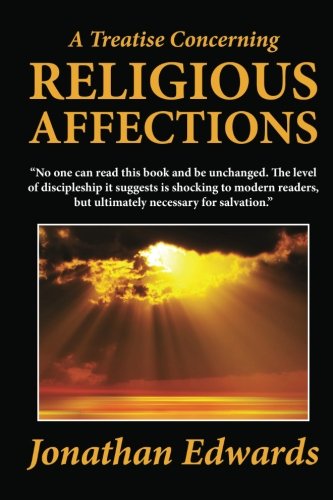 From Wikipedia:
Edwards wrote the Treatise to explain how true conversion to Christianity occurs. Edwards describes how emotion and intellect both play a role, but "converting grace" is what causes Christians to "awaken" to see that forgiveness is available to all who have faith that Jesus' sacrifice atones for all sins. This salvation is not possible through believers' imperfect good works which are simply evidence of faith, and only possible through Christ's sacrifice which is free to all. Edwards describes the importance of testing new faith and discerning whether it is legitimate. He lays out twelve tests of true conversion, including ways of measuring allegedly fruitful works. He basically concludes that the fruit of the Spirit are the religious affections, love being the chief affection, and that all other fruit (or Christian virtues) flow from this. "Love is the chief of the affections, and as it were the fountain of them." (p.76, Banner of Truth Edition). He further says "for it was not by men's having the gifts of the Spirit (referring to spiritual gifts), but by their having the virtues of the Spirit, that they were called spiritual." (p.127). This is how you can distinguish between carnal men and spiritual men. Carnal men do not produce the fruit of the Spirit, but spiritual men do. So it was with Christ. "All the virtues of the Lamb of God, His humility, patience, meekness, submission, obedience, love and compassion, are exhibited to our view in a manner the most tending to move our affections of any that can be imagined." (p.53)
 This was recommended as one of the three books to read about Doctor Samuel Johnson. He was a very godly man and wrote out many prayers that were made into this little book.
 Here was a man who seemed to me to excel all the authors I had read in conveying the very quality of life as we live it from moment to moment, but the wretched fellow, instead of doing it all directly, insisted on mediating it through
| LOVE (III) by George Herbert Love bade me welcome, yet my soul drew back, Guilty of dust and sin. But quick-ey'd Love, observing me grow slack From my first entrance in, Drew nearer to me, sweetly questioning If I lack'd anything. "A guest," I answer'd, "worthy to be here"; Love said, "You shall be he." "I, the unkind, the ungrateful? ah my dear, I cannot look on thee." Love took my hand and smiling did reply, "Who made the eyes but I?" "Truth, Lord, but I have marr'd them; let my shame Go where it doth deserve." "And know you not," says Love, "who bore the blame?" "My dear, then I will serve." "You must sit down," says Love, "and taste my meat." So I did sit and eat. Notice the way he wrote this with the BOLD! That LIFE hath with the sun a double motion. The first IS straight, and our diurnal friend : The other HID, and doth obliquely bend. One life is wrapt IN flesh, and tends to earth ; The other winds t'wards HIM whose happy birth Taught me to live here so THAT still one eye Should aim and shoot at that which IS on high— Quitting with daily labour all MY pleasure, To gain at harvest an eternal TREASURE. (from: http://www.luminarium.org/sevenlit/herbert/colossians.htm) I loved these poems. They are not always the easy to understand, but they are well worth it! Two thumbs UP! |
I was going to use a prompt from Julie's Bravewriter website, but I decided to just write on whatever without a prompt. It has been a w...


